Best Gear
Best Fermenters for Home Brewing
The Diboshi 35L Stainless Conical Fermenter is the best all-around fermenter for most home brewers at $139.00, giving a true conical bottom for yeast harvesting without the four-figure price of the largest tanks in this catalog.
Brewers who just need a reliable sealed vessel for 5-gallon batches are just as well served by the $31.95 FastRack bucket or the $47.95 Fermonster carboy.

Diboshi 35L Stainless Conical Fermenter (316)
Diboshi
It is the cheapest true stainless conical in this catalog, letting a brewer harvest yeast and drop trub through a bottom valve instead of racking off the top, at a price close to a premium plastic bucket setup.
Price last checked at publication and changes often.
What actually decides this purchase
Every fermenter in this catalog does the same basic job: hold sweet or fermenting wort or must sealed away from oxygen and contamination while yeast works. What separates a $31.95 bucket from a $930 conical is what happens after primary fermentation slows, not during it. A bucket or carboy holds beer on top of the yeast cake until a brewer racks it off with a siphon. A conical has a valve at the bottom of a cone-shaped base, so yeast and trub settle into the point and can be dumped or harvested without ever touching the beer above.
Material is the second real variable. Food-grade plastic, including buckets and PET carboys like the Fermonster, is light, inexpensive and hard to damage by dropping it empty, but it can scratch, and scratches can hide bacteria if cleaning is careless. Glass carboys are chemically inert and easy to inspect for cleanliness, but a full glass carboy is heavy enough that carrying it solo, especially on stairs, deserves real caution, and it can shatter if it is dropped or knocked against a doorframe. Stainless steel, used in every conical here, does not scratch or stain and is the material used in almost all commercial fermentation, but it costs the most per gallon of capacity.
Capacity relative to batch size is the point most new brewers get wrong. A standard batch is 5 gallons of finished beer, but fermentation produces a rocky foam layer called krausen that can take up a large share of the vessel during a vigorous fermentation. The long-standing home-brewing convention is that a 5-gallon batch wants roughly a 6.5-gallon fermenter, and that convention is why so many of the buckets and carboys in this catalog are sized at 6 to 7 gallons rather than exactly 5.
- Bottom-dumping trub and yeast without racking, versus siphoning off the top
- Plastic and PET (light, cheap, can scratch) versus glass (inert, heavy, can shatter) versus stainless (durable, most expensive)
- Headspace for krausen: a 5-gallon batch wants roughly 6.5 gallons of vessel
How the fermenter styles compare
| Style | Example | Capacity | Price | Best for |
|---|---|---|---|---|
| Plastic bucket | FastRack 6.5 Gallon Fermenting Bucket | 6.5 gal | $31.95 | First batches, budget setups |
| Wide-mouth PET carboy | Fermonster 7 Gallon Carboy | 7 gal | $47.95 | Watching fermentation, avoiding glass |
| Glass carboy | North Mountain Supply 6.5 Gallon Carboy | 6.5 gal | $96.99 | Brewers who want an inert, scratch-proof vessel |
| Stainless conical | Diboshi 35L Stainless Conical Fermenter (316) | 35 L (about 9.25 gal) | $139.00 | Harvesting yeast, dropping trub without racking |
| Pressure-rated fermenter | VEVOR Pressure Fermenter 15 PSI | 8 gal | $193.90 | Closed transfers and carbonating in the fermenter |
Buckets and carboys still make sense
A conical is not automatically the right upgrade. A brewer who racks to secondary rarely, bottles instead of kegging, and just wants a sealed vessel with an airlock has little to gain from a bottom valve. Buckets are also opaque, which some brewers actually prefer, since it keeps fermenting beer out of light. The FastRack bucket in this catalog ships with a gasketed lid and grommet for a three-piece airlock, and a bucket paired with a bottling bucket and spigot is still the cheapest complete path from wort to bottle.
Carboys split the difference. Glass has been the traditional choice because it does not absorb odor and shows fermentation activity clearly, but wide-mouth PET carboys like the Fermonster have mostly displaced glass for anyone who has ever dropped one. A 7-gallon PET carboy holds a full 5-gallon batch with real headspace, and unlike a narrow-mouth glass carboy, it opens fully by hand for dry hopping or cleaning rather than needing a bottle brush on a stick.
When a conical earns its price
The case for spending $139 to $930 on a conical is narrower than marketing suggests. A conical helps most when a brewer wants to repitch yeast from batch to batch, since dumping the trub cake through a bottom valve into a jar is far cleaner than scooping it out of a bucket. It also helps with hazy or fruited styles where a heavy layer of hop material or fruit settles hard, because that material can be dropped mid-fermentation without disturbing the beer above it.
The spread in this catalog, from a $119 Diboshi 20L up to a $930 Diboshi 30.4-gallon tank, mostly reflects capacity rather than a different basic design. Most home brewers making 5-gallon batches do not need a 30-gallon conical; that size exists for brewers scaling toward small commercial batches or running several 5-gallon batches through one large vessel. Choosing a conical in the 20 to 35 liter range covers a standard 5-gallon batch with the recommended headspace and keeps the price under $150.
Airlocks, spigots and the small parts that decide day-to-day convenience
Every fermenter needs an airlock or a blow-off tube to let CO2 escape while keeping outside air out, and that piece is usually not included with a bare bucket or carboy. A three-piece airlock, like the FastRack version in this catalog at $8.95, is the standard, cheap way to do this and it is easy to take apart for cleaning between batches. A twin bubble airlock does the same basic job with a different internal shape, and either style provides working pressure relief as long as it stays filled with sanitizer solution and is not blocked by krausen.
A spigot near the bottom of a bucket, whether built in like the U.S. Solid fermenter or added separately like the Ferroday spigot at $6.99, changes how a brewer racks beer more than it changes fermentation itself. Racking through a spigot means gravity does the work and there is no siphon to start; racking through an auto-siphon, like the Fermtech models in this catalog priced from $15.99 to $19.99, works on any fermenter without a spigot but takes a bit more technique to get flowing without splashing and picking up oxygen. Neither method changes the beer's flavor if done carefully; the choice is really about what feels easier to a given brewer.
These small parts add up in total cost more than they look like they should. A bucket at $31.95 still needs an airlock, and a way to transfer beer out, whether a spigot or an auto-siphon. Budgeting for the full kit around a fermenter, not just the vessel itself, avoids a surprise on the first brew day when there is wort ready to go and no way to seal or empty the vessel.
- A three-piece airlock keeps working only if it stays filled with sanitizer and clear of krausen
- A spigot lets gravity do the racking; an auto-siphon works on any fermenter but takes more technique
- Price the airlock and the transfer method into the total cost, not just the vessel itself
Cleaning and inspecting a fermenter between batches
A fermenter is only as sanitary as its last cleaning, and the material a brewer chooses changes how that cleaning actually goes. Plastic buckets and PET carboys scratch more easily than glass or stainless, and a scratch that is not cleaned thoroughly can shelter bacteria or wild yeast between batches. A dedicated carboy brush, like the Tapcraft model in this catalog, reaches into a narrow carboy neck to scrub the inside without a hand fitting through, while a bucket's wide opening lets a brewer clean it by hand with a cloth or a shorter brush.
A soak in an alkaline cleaner such as PBW is the standard first step for any fermenter with visible residue, since it breaks down the proteins and trub left behind by wort far better than soap and water alone. That should always be followed by a sanitizer like Star San, rinsed or left to air dry before the next batch, since a clean vessel is not automatically a sanitized one. Stainless conicals add one more spot to check: the bottom valve, where trub can pack into the threads and seals if it dries there instead of being flushed out promptly after racking.
None of this differs meaningfully by fermenter style once the cleaning routine is in place; a well-cleaned bucket is exactly as sanitary as a well-cleaned conical. The practical difference is how forgiving each material is of an imperfect cleaning, and stainless is the most forgiving of the three.
How we chose
These picks come from the published capacities, materials and pressure ratings listed by each manufacturer, cross-checked against verified owner reviews on the retail listing for each product. Nobody on this site has fermented a batch in every vessel listed here; the comparisons are built from specifications and from what owners report after months of real use, not from hands-on testing in a shop.
The three tiers
These are three genuinely different builds, not the same product at three prices. Buy the tier that matches how much you already know you will use it.
FastRack 6.5 Gallon Fermenting Bucket with Lid
FastRack
At $31.95 this is the cheapest complete fermenter in the catalog with a gasketed lid ready for an airlock, and it is the easiest vessel to clean and inspect since it opens fully at the top. It has no bottom valve, so harvesting yeast means opening the lid and scooping, which is the tradeoff for the low price.
$31.95
View on AmazonFermonster 7 Gallon Wide Mouth Carboy
FastRack
A 7-gallon wide-mouth PET carboy at $47.95 gives a 5-gallon batch real headspace, will not shatter if it is dropped like glass, and can be opened fully by hand for dry hopping, all while staying under $50.
$47.95
View on AmazonDiboshi 30.4 Gallon Stainless Conical Fermenter
Diboshi
At $930.00 for 30.4 gallons of stainless capacity, this is built for brewers running large or combined batches through one vessel, not a single 5-gallon batch. Anyone brewing standard 5-gallon batches should not buy this; a 20 to 35 liter conical does the same job for a small fraction of the price.
$930.00
View on AmazonEverything else worth considering

U.S. Solid 6.5 Gallon Fermenter with Airlock and Spigot
Food grade BPA-free primary fermenter supplied with both an airlock and a bottling spigot.

FastRack 6.5 Gallon Fermenting Buckets with Lids (2 pack)
Two BPA-free food grade HDPE buckets with drilled lids and airlocks, which covers primary and bottling in one purchase.

Italian 6 Gallon Glass Carboy
Clear glass carboy that lets you watch fermentation, and does not scratch or hold odours the way plastic can.

VEVOR 8 Gallon Stainless Brew Bucket Fermenter
Flat bottomed stainless fermenter with a sampling valve, easier to clean than a conical.
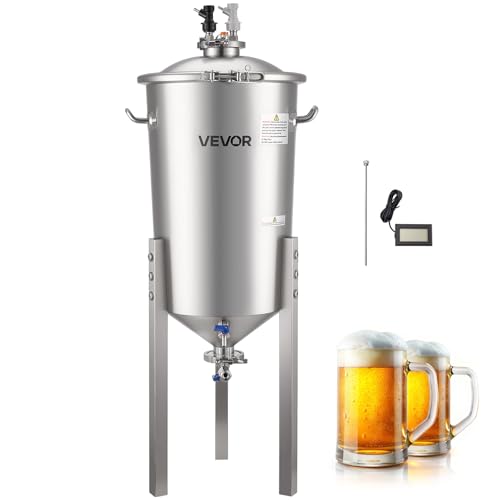
VEVOR Pressure Fermenter 15 PSI (8 gal)
Eight gallon stainless pressure-capable conical, sized for five gallon batches.

WELONSTAR 17 Gallon Stainless Conical Fermenter
Wide mouth seventeen gallon stainless conical for beer and wine, with a dump valve for trub and yeast.

Speidel 60L Plastic Fermenter (15.9 gal)
German made HDPE fermenter with a wide lid, sized for ten gallon batches.

Diboshi 20L Stainless Conical Fermenter (316)
Twenty litre 316 stainless conical for small or split batches.
Before you do this
A fermenter filled to the brim with a 5-gallon batch pushes krausen straight into the airlock. Sizing to roughly 6.5 gallons for a 5-gallon batch is the single easiest way to avoid a fermentation mess or a clogged airlock.
Related on BrewGearCalc
- Best conical fermenters
- Best carboys and fermenting buckets
- Best pressure fermenters
- Yeast pitch calculator
- Hydrometer correction calculator
Frequently asked questions
- What size fermenter do I need for a 5-gallon batch?
- Plan on roughly 6.5 gallons of vessel capacity for a 5-gallon batch. That extra headspace is not padding, it is where krausen, the rocky foam layer that forms during active fermentation, needs somewhere to go. Filling a fermenter to the brim with a 5-gallon batch risks pushing krausen straight into the airlock, which can clog it or push liquid out around the lid. A 6 to 7 gallon bucket, carboy or conical gives that foam room without a mess.
- Is a conical fermenter worth it over a bucket for a beginner?
- Not usually, at least not for the first several batches. A conical's real advantage is harvesting yeast and dropping trub through a bottom valve, which matters most to brewers repitching yeast or chasing very clear beer. A first-time brewer gets the same fermentation quality from a $31.95 bucket, and can always upgrade to a conical later once the basics of sanitation and temperature control are comfortable and the extra features actually get used.
- Plastic, glass or stainless: which fermenter material lasts longest?
- Stainless steel lasts the longest and resists scratching and staining better than either plastic or glass, which is why it is used in almost every conical fermenter. Glass is close behind for durability of the material itself but can fail suddenly if dropped or chipped. Food-grade plastic and PET are the least durable over many years of scratching, but a scratched plastic vessel that is still cleaned properly is not automatically unsafe, it just needs closer inspection over time.
- Can I ferment and carbonate in the same vessel?
- Yes, but only in a vessel actually rated for pressure, such as the VEVOR pressure fermenters in this catalog, rated to 15 PSI. A standard bucket, carboy or non-pressure-rated conical is not built to hold back the CO2 produced during active fermentation and must never be sealed tight the way a rated pressure vessel can be. See the pressure fermenter picks for the safety details before trying this.
- How do I know when to move up from a bucket to a conical?
- The clearest sign is wanting to repitch yeast from one batch into the next without scooping a trub cake out of an open bucket, or brewing styles that leave heavy sediment, like hazy IPAs or fruited beers, where dropping trub mid-fermentation helps clarity. If neither of those applies and the current bucket or carboy setup is producing beer that tastes right, there is no fermentation quality gained by switching to a conical.
- Do wide-mouth carboys crack like glass ones?
- No. Wide-mouth carboys like the Fermonster are made from PET, the same shatter-resistant plastic used in reusable water bottles, and they do not crack or shatter the way glass does when dropped. They can still scratch with rough handling or an abrasive brush, and scratches should be cleaned carefully, but a dropped PET carboy is far less likely to end a brew day than a dropped glass one.
Researched from published brewing formulas, manufacturer specifications and verified owner reviews. This is general guidance, not professional advice.