Calculator
IBU Calculator
Tinseth and Rager, both labelled, because they disagree by a predictable margin.
Rager systematically returns a higher figure than Tinseth for the same hops, often around a third higher at full boil times. Neither is the true value: calculated IBU is a model of how much isomerised alpha acid should end up in the beer, while a laboratory IBU measures what actually did. Stay with one model so your own recipes stay comparable.
The formula
Rager systematically returns a higher figure than Tinseth for the same hops, often around a third higher at full boil times. Neither is the true value: calculated IBU is a model of how much isomerised alpha acid should end up in the beer, while a laboratory IBU measures what actually did. Stay with one model so your own recipes stay comparable.
What rests on a standard and what rests on convention
- Standard Both the Tinseth and Rager equations are published.
- Convention The BU to GU ratio as a balance guide is convention, not a standard.
A standard is a published equation, a published constant or a manufacturer specification. A convention is widely repeated brewing practice with no governing document behind it. Both are useful. Confusing one for the other is how a habit ends up being quoted as a fact.
Hops, hop baskets and scales
This grid re-orders itself against the numbers you enter above. Prices are those returned when the page was built and change often.

Cascade Pellet Hops (1 lb)
A pound of Cascade pellets, the classic American aroma hop, which is far cheaper per ounce than small packets.

Centennial Hop Pellets (8 oz)
Half pound of Centennial, a dual purpose American hop.

BSG Mosaic Hop Pellets (8 oz)
Half pound of Mosaic, a high impact aroma hop for dry hopping.
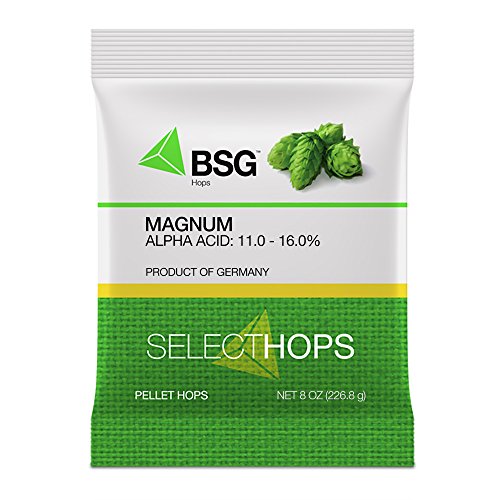
BSG Magnum Hop Pellets (8 oz)
High alpha bittering hop, which delivers a given IBU from a smaller weight of hops.

Citra Pellet Hops (1 oz)
Single ounce of Citra, the usual quantity for one late or dry hop addition.

YCH Citra Hop Pellets (1 lb)
A full pound of Citra for brewers dry hopping heavily and often.

TIZZE Hop Spider (300 micron)
Stainless mesh basket that keeps hop matter out of the wort, which makes transfer far cleaner.

TIZZE 4 x 10 inch Hop Spider
Four by ten inch 300 micron hop filter that hangs in the kettle.

Hop Hopper Spider Strainer Basket (6 x 14 inch)
Larger hop basket for heavily hopped ten gallon batches.

Digital Pocket Scale 200 g x 0.01 g
Hundredth of a gram resolution, which is the precision hop additions and water salts actually need.

BOMATA 1 kg x 0.01 g Digital Scale
Wider range 0.01 g scale, which covers both salt additions and whole hop packets.

Bonvoisin Digital Lab Scale 600 g x 0.01 g
Laboratory balance with a draft shield style body, for brewers building water profiles by the tenth of a gram.
Related on BrewGearCalc
Frequently asked questions
- Why do Tinseth and Rager disagree?
- They are separate published models fitted to different data, and they make different assumptions about how much alpha acid isomerises during the boil. Rager generally reads higher. Because calculated IBU is a prediction rather than a measurement, neither can be called correct. What matters is that you use one consistently, so a recipe that tasted right last time gives the same number next time.
- Does boil gravity really change bitterness?
- Yes, substantially, and both models account for it. Sugar in the wort suppresses isomerisation of alpha acids, so the same hop charge yields fewer IBU in a strong wort than in a weak one. This is why high gravity beers need proportionally more hops to taste equally bitter, and why late additions to a concentrated boil underperform.
- Do dry hops add IBU?
- Not meaningfully in the calculated sense, because dry hopping happens cold and alpha acids need heat to isomerise. Dry hops add aroma and can increase perceived bitterness through other compounds, which is why a heavily dry hopped beer can taste sharper than its calculated IBU suggests. Neither model attempts to predict that.
Researched from published brewing formulas, manufacturer specifications and verified owner reviews. This is general guidance, not professional advice.