Guides
How to Use Star San and PBW
Star San is used at Five Star's long-standing label dilution of about 1 fluid ounce per 5 gallons of water, which brings the solution to a low pH where it needs no rinse and works with as little as 30 seconds of contact time on an already clean surface.
PBW is typically mixed at roughly 1 to 2 ounces per gallon of hot water and needs real soak time, often 20 to 30 minutes for routine soil and considerably longer for heavy beerstone, followed by a full water rinse.
Why the order and the dilution both matter
Star San and PBW solve two different problems, and using either one at the wrong step or the wrong strength wastes the product without actually protecting your beer. PBW cleans, which means it needs contact time against soil and always gets rinsed off afterward. Star San sanitises, which means it goes on last, at a specific dilution, and stays on rather than being rinsed away. Mixing either one too weak reduces its effectiveness, and mixing PBW too strong for too long on the wrong material can damage that material instead of just cleaning it.
Star San in practice
The standard label dilution for Star San is about 1 fluid ounce per 5 gallons of water, which drops the solution to a pH near or below 3, the range where the acid sanitiser does its job. At that dilution, a brief contact time, commonly cited as 30 seconds, is enough on a surface that is already visibly clean. There is no rinse step: pour it in, swirl or spray to coat every surface that will touch wort or beer, and let it drain or air dry.
A mixed Star San solution stays effective as long as it holds that low pH, and many brewers use pH strips to check an older batch of solution rather than guessing from appearance. Foam thinning out or the solution going slightly cloudy over time is a widely used rule of thumb among brewers for judging when to remix, but it is a convention rather than a guaranteed indicator, and a pH check is the more reliable way to know for certain.
Saniclean for pumps, lines, and recirculating systems
Saniclean is Five Star's low-foaming counterpart to Star San, built around the same acid-sanitiser idea but formulated to produce far less foam when agitated. That matters most when sanitiser is being pumped through beer lines, a plate chiller, or recirculated through a system with narrow tubing, where heavy Star San foam can cause air lock or uneven contact inside the lines. For a simple carboy, bucket, or bottle, either product does the job, but Saniclean is the better fit anywhere a pump is moving the solution around.
PBW in practice
PBW is mixed considerably stronger than Star San because it has real cleaning work to do rather than just reducing microbes on a surface that is already bare. A common working range is roughly 1 to 2 ounces of PBW per gallon of hot water, and warm or hot water noticeably speeds up how quickly it breaks down soil compared with cold water. Routine cleaning after a batch often needs only 20 to 30 minutes of soak time, while heavy, long-neglected beerstone inside a carboy or keg can call for an overnight soak instead.
PBW works on stainless steel, glass, and most food-grade plastics without damaging them, which is a large part of why it is the standard cleaner across home brewing. Aluminum is the notable exception: extended PBW contact can dull or etch an aluminum kettle or pot, so a shorter contact time and a prompt rinse, rather than an overnight soak, is the safer approach on aluminum equipment specifically.
Comparing the options side by side
| Product | Job | Typical dilution | Contact time | Foam level | Rinse |
|---|---|---|---|---|---|
| Star San | Sanitiser (acid) | About 1 oz per 5 gal water | 30 seconds on a clean surface | High | No, no-rinse |
| Saniclean | Sanitiser (acid, low foam) | Per label, similar range to Star San | 30 seconds on a clean surface | Low | No, no-rinse |
| PBW | Cleaner (alkaline) | About 1 to 2 oz per gallon, hot water | 20 to 30 minutes, longer for heavy soil | Low | Yes, rinse fully |
| One Step | Combined light cleaner/sanitiser | Per label | Per label | Low to moderate | No, no-rinse |
Never mix them, and never let them share a bottle
It is worth saying plainly: PBW and Star San should never be combined in the same container or applied to a surface back to back without a water rinse in between. One is alkaline and the other is acid, and mixing them neutralizes both, which means you end up with neither a working cleaner nor a working sanitiser. Beyond wasting product, combining a caustic cleaner with an acid sanitiser can react and splash, which is a real safety concern, not just an efficiency one. Keep the two in clearly labeled, separate containers and always rinse thoroughly between the PBW step and the Star San step.
A practical routine for a normal brew day
For most home brewers, a workable routine looks the same every time regardless of batch size: rinse equipment right after use before anything dries on, soak in PBW solution for real contact time once soil has had a chance to loosen, rinse fully with clean water until no suds remain, then mix a fresh or verified Star San or Saniclean solution and apply it right before the equipment touches wort or beer. Doing the PBW soak soon after a brew day, rather than weeks later, also means less scrubbing overall, since dried-on residue takes longer to break down than fresh residue does.
Buying the right size for how often you brew
Star San and PBW are both sold across a range of package sizes, and matching the size to your actual brewing frequency avoids either running out mid-batch or having concentrate sit unused for a long stretch. A small bottle of Star San concentrate goes a long way at its dilution rate, since a single ounce covers 5 gallons of working solution, so even an occasional brewer can get many batches out of a smaller bottle. A brewer running batches often, or cleaning multiple kegs and carboys in the same session, gets more practical value from a larger container or a combined bundle that covers both the cleaning and sanitising steps in one purchase.
PBW works a little differently, since it is measured by weight rather than fluid ounces and gets used up faster per session because of its higher working concentration. A pound of PBW is a reasonable starting size for a brewer just getting into a regular cleaning routine, while a multi-pound container makes more sense once cleaning kegs, coolers, and fermenters on a regular schedule is already part of the routine rather than an occasional task.
Storage and shelf life between batches
Both products keep reasonably well in their concentrated, unmixed form when stored in a closed container away from direct heat and sunlight, which matters more for a brewer who cleans and sanitises only every few weeks rather than every few days. Mixed solution is a different story: a diluted PBW solution loses cleaning power once it cools and once the soil it has already absorbed builds up, so it is generally mixed fresh for each cleaning session rather than stored and reused indefinitely.
Mixed Star San solution holds up considerably longer than mixed PBW, since its usefulness is tied directly to pH rather than to how much soil it has already absorbed, which is why many brewers keep a batch of Star San solution on hand in a spray bottle or bucket between brew days rather than remixing every single time it is needed.
Why hard water shortens a Star San batch
Water hardness works against Star San in a specific, mechanical way. The minerals dissolved in hard water, mainly calcium and magnesium, react with the acid in solution and gradually neutralize the low pH that makes Star San effective in the first place. A batch mixed with very hard tap water can drift out of its effective pH range noticeably sooner than the same batch mixed with softer water, even though nothing about how it was used changed. This is a real, checkable reason a mixed batch that "should" still be good can already need remixing, and it is also why brewers on hard water sometimes reach for filtered or distilled water specifically for mixing sanitiser, even when their brewing water itself does not need that treatment.
A pH strip removes the guesswork either way, since it tells you directly whether a given batch of solution, regardless of what your tap water is like, is still within range rather than making you estimate from how long it has been sitting.
What PBW does that scrubbing alone cannot
Baked-on trub and dried fermentation residue are not simply stuck to a surface the way dust is, they are bonded organic material, proteins and sugars that have denatured and hardened in place. A brush or scrub pad can knock loose the top layer of that residue, but it tends to burnish or smear the rest rather than removing it, especially in a hard-to-reach spot like a kettle seam or the shoulder of a carboy where a brush cannot apply even pressure. PBW works by a different mechanism entirely: its alkaline, oxygen-releasing chemistry breaks the residue down at a molecular level over the course of a soak, lifting it off the surface rather than requiring it to be physically scraped away.
This is why a long soak in properly mixed PBW solution routinely clears residue that stubbornly resisted an hour of scrubbing with a brush and hot water alone, and it is also why reaching for a stronger scrub pad on stuck residue is usually the wrong fix. A metal scouring pad can scratch stainless steel and create tiny grooves that are actually harder to keep clean going forward, where a proper soak leaves the original surface intact.
Everything else worth considering
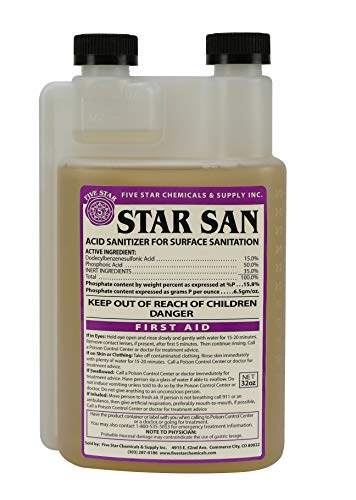
Five Star Star San (32 oz)
High foaming no-rinse acid sanitiser. One ounce treats five gallons, so a single bottle lasts most brewers a very long time.

Five Star Star San 16 oz (2 pack)
Two smaller bottles of the same no-rinse sanitiser.

Five Star Star San (1 gallon)
Gallon of food grade acid sanitiser, sensible only for brewers running kegs and multiple fermenters.

Five Star Saniclean (32 oz)
Low foaming acid sanitiser, which suits recirculating through pumps and beer lines where Star San would foam too much.
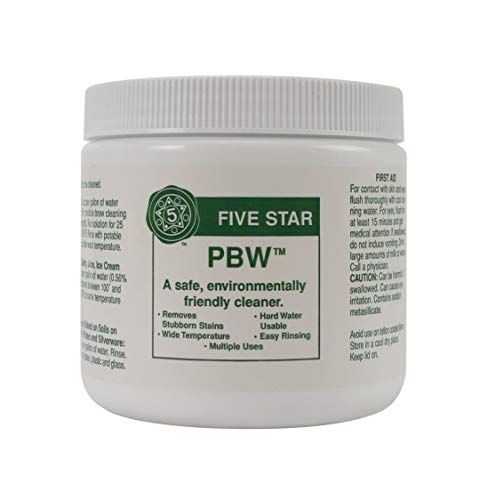
Five Star PBW (1 lb)
Non-caustic alkaline brewery wash that lifts baked-on trub without scrubbing. It is still an alkaline cleaner and needs gloves and eye protection.

Five Star PBW Cleanser (4 lb)
The four pound tub, which is the sensible size once you are brewing regularly.
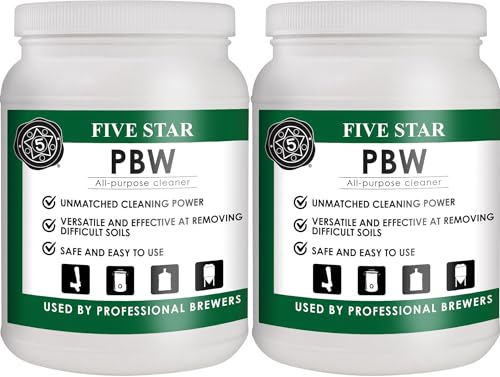
Five Star PBW 4 lb (2 pack)
Eight pounds of alkaline brewery wash for kettles, kegs and fermenters.

Five Star PBW Liquid (32 oz)
Liquid PBW, which dissolves instantly instead of needing warm water to go into solution.

Five Star PBW Tablets (12 count)
One tablet per gallon, which removes the weighing step for growlers, carboys and kegs.

Star San 32 oz and PBW 1 lb Bundle
The cleaner and the sanitiser together, which is the pair every brewer needs and beginners often confuse.
Before you do this
PBW is alkaline and can burn skin and eyes, so use gloves and eye protection when mixing or handling concentrated solution. Never mix PBW and Star San together in the same container or apply one right after the other without a full water rinse in between: combining a caustic cleaner with an acid sanitiser can react, and it destroys the effectiveness of both products.
Related on BrewGearCalc
Frequently asked questions
- How much Star San do I mix per gallon of water?
- Five Star's standard label dilution works out to about 1 fluid ounce of Star San per 5 gallons of water, which brings the solution to a low pH, generally at or below 3, where it needs no rinse. Always check the specific bottle you have for the exact printed ratio, since concentration can vary slightly between package sizes, but this is the widely used starting point most brewers mix to.
- Why is my Star San solution so foamy, is that a problem?
- No, heavy foaming is normal for Star San, especially when it is shaken, sprayed, or pumped. The foam is at the same low pH as the liquid, so it is still sanitising anything it touches. There is nothing to rinse off. If foam is a practical nuisance in pumps or beer lines specifically, Saniclean is the low-foaming version built for exactly that situation.
- Can I reuse a batch of Star San solution?
- Yes, as long as it still holds a low pH, generally at or below 3. Many brewers use pH strips to check an older batch rather than guessing from foam or clarity, since foam thinning out is a commonly cited but not fully reliable signal that a batch needs remixing. When in doubt, mixing a fresh batch is inexpensive and removes the guesswork entirely.
- How long should I soak equipment in PBW?
- Routine cleaning after a normal brew day typically needs about 20 to 30 minutes of soak time in a properly mixed PBW solution, using warm or hot water to speed up the process. Heavy, long-neglected soil or beerstone inside a carboy or keg often needs a longer soak, sometimes overnight, and may need a second round if the first pass does not fully clear it.
- Can I use PBW on an aluminum kettle?
- Use caution. PBW works well on stainless steel, glass, and most plastics, but extended contact can dull or etch aluminum surfaces. If you do use it on aluminum, keep contact time shorter than a routine stainless soak and rinse promptly rather than letting it sit for an extended or overnight soak.
- What happens if PBW and Star San get mixed together?
- They neutralize each other, since PBW is alkaline and Star San is acid, which means you lose the effectiveness of both. Combining a caustic cleaner with an acid sanitiser can also react and splash, so it is a genuine safety concern, not just wasted product. Store them in separate, clearly labeled containers and always rinse between using one and the other.
Researched from published brewing formulas, manufacturer specifications and verified owner reviews. This is general guidance, not professional advice.