Compare
Pressure Fermentation vs Traditional
For most home brewed ales, traditional open fermentation under an airlock, in a vessel like the Diboshi 20L Stainless Conical Fermenter at $119.00, produces beer that is indistinguishable from the same recipe fermented under pressure.
Pressure fermentation earns its cost and added complexity specifically when you want to transfer finished beer straight into a keg without exposing it to oxygen, which matters most for hazy hop forward styles and for fermenting some yeast strains warmer than usual without the off flavors that would normally produce.

Diboshi 20L Stainless Conical Fermenter (316)
Diboshi
It ferments a standard five gallon batch of ale to the same quality as a pressure fermenter costing well over double, without adding a relief valve, a spunding setup or a pressure rating to manage.
Price last checked at publication and changes often.
What pressure fermentation actually changes
A pressure rated fermenter lets carbon dioxide build up inside the sealed vessel instead of escaping through an airlock. That pressure does three real things: it lets you transfer beer to a keg through a closed line without exposing it to outside air, it can carbonate beer in the fermenter itself, and it suppresses some of the fruity esters that certain yeast strains, especially kveik strains, would otherwise produce at warm fermentation temperatures.
None of that changes how well the yeast converts sugar to alcohol. A pressure fermenter and a traditional airlock fermenter produce the same attenuation from the same yeast pitched into the same wort, at the same temperature.
Closed transfer: the single biggest reason to choose pressure
Oxygen picked up after fermentation is one of the most common causes of beer going stale or losing hop aroma faster than it should, and it usually happens during racking and packaging, not during fermentation itself. A pressure fermenter lets you push finished beer straight into a purged keg through a sealed line, with essentially no exposure to air. That single capability is the strongest, most concrete reason to pay for pressure fermentation, and it matters most for hazy IPAs and other hop forward styles, where oxidation shows up fastest as a flavor change.
A traditional open fermenter can still reach a reasonably low oxygen transfer with careful technique, a purged keg and a short length of tubing kept submerged, but it cannot match a fully sealed, pressurised closed transfer.
What you give up choosing pressure
Pressure fermenters cost more: the VEVOR Pressure Fermenter at 8 gallons runs $193.90, and the 16 gallon version runs $314.50, against $119.00 to $219.00 for stainless conicals of similar size that only handle atmospheric pressure. A pressure vessel also requires you to actually manage that pressure correctly, watching a gauge and a relief valve, rather than just topping off an airlock with sanitiser and forgetting about it.
For a brewer who bottles rather than kegs, a pressure fermenter's main advantage, the closed transfer into a keg, does not really apply. Bottling still means opening the vessel to prime and fill bottles, which erases most of the oxygen benefit pressure fermentation offers in the first place.
Fermenting warm without the fruity trade-off
Kveik and some other warm tolerant yeast strains are prized for finishing fermentation fast at temperatures that would push most ale yeasts into producing noticeably fruity or solvent-like flavors. Fermenting these strains under pressure suppresses a portion of that ester production, which is why pressure fermentation and kveik strains are frequently mentioned together by brewers chasing a cleaner result at warm temperatures.
This is a real, documented interaction between pressure and yeast metabolism, not a marketing claim specific to any one fermenter. It only matters, though, if you are actually fermenting warm on purpose; a lager or a standard ale fermented at its normal recommended temperature range gets no ester-suppression benefit from being pressurised, since there is little excess ester production to suppress in the first place.
What oxygen actually does to finished beer
Oxygen dissolved into beer after fermentation reacts slowly with compounds in the beer over the following weeks, a process brewers call staling. The most noticeable effect in hoppy styles is a fading of fresh hop aroma, since many of the aromatic hop compounds are themselves vulnerable to oxidation; a hazy IPA that tasted vibrant on packaging day can taste noticeably flatter and more cardboard-like within a month if it picked up meaningful oxygen during racking. Malt forward styles show the same staling process more slowly, often as a shift toward a papery or sherry-like character over a longer stretch.
This is why closed transfer matters more for some styles than others. A hop forward beer loses its main selling point, fresh aroma, fastest when oxidized, which is exactly why pressure fermentation and closed transfers became closely associated with hazy IPA brewing specifically. A dark, malty beer with less delicate hop character has more room to tolerate ordinary racking technique before the difference becomes noticeable to most drinkers.
The suction risk traditional airlock brewers never think about
A sealed, pressure rated vessel introduces a failure mode in the opposite direction from bursting: as fermentation finishes and the beer inside cools, the gas in the headspace contracts, and a vessel with no way to relieve that changing pressure can pull inward under vacuum rather than push outward. A vessel not designed to handle negative pressure can deform or collapse under that suction, the same way a sealed plastic bottle can crumple as its contents cool. Only pressurise a vessel that is actually rated for it and fitted with a relief path that works in both directions, not just a one-way pressure release valve.
The full cost, and what the choice locks you into
Pressure fermentation is not a one-time purchase the way a bucket is. Beyond the fermenter itself, a spunding valve, extra gas fittings for a closed transfer, and a keg to actually receive that transfer all add to the real cost of using the system the way it is designed to be used. A brewer who buys a pressure fermenter but keeps racking the old way, opening the lid and siphoning, has paid for a capability they are not actually using.
The commitment also runs the other direction: once a setup is built around closed transfers, going back to open racking for a single batch, because a fitting broke or a keg was not purged in time, reintroduces exactly the oxygen exposure the whole system was bought to avoid. Consistency, not just equipment, is what makes pressure fermentation pay off over time.
Carbonating in the vessel instead of in the keg
A pressure fermenter fitted with a spunding valve can hold a chosen pressure as fermentation finishes, which carbonates the beer using its own fermentation CO2 rather than injecting CO2 separately after packaging. Done well, this saves a step and some CO2 compared with force carbonating a keg afterward.
It does require watching the process rather than walking away entirely: holding a spunding valve too tight too early, while active fermentation is still producing a lot of CO2, can push the pressure past a comfortable working range faster than a brewer expects. Following the published guidance for the specific fermenter and valve you are using, rather than guessing at settings, is the safer path here.
How we chose
These picks reflect published pressure ratings, capacities and features for each vessel, plus how kegging and closed transfer techniques are documented by manufacturers and experienced brewers, not personal side by side fermentation testing.
Pressure vs traditional fermenters compared
| Fermenter | Type | Capacity | Price |
|---|---|---|---|
| FastRack 6.5 Gallon Fermenting Bucket | Traditional, airlock | 6.5 gal | $31.95 |
| Diboshi 20L Stainless Conical Fermenter | Traditional, airlock | 5.3 gal | $119.00 |
| VEVOR Pressure Fermenter 15 PSI | Pressure rated | 8 gal | $193.90 |
| VEVOR Pressure Fermenter 15 PSI | Pressure rated | 16 gal | $314.50 |
Who should buy which
If you bottle, or you keg but have not run into oxidation problems that bother you, traditional airlock fermentation is doing everything you need it to. If you keg regularly, chase hop aroma in hazy styles, or ferment kveik and other warm tolerant strains and want to avoid the fruitiness that heat usually brings, pressure fermentation is solving a real, specific problem for you rather than adding complexity for its own sake.
The three tiers
These are three genuinely different builds, not the same product at three prices. Buy the tier that matches how much you already know you will use it.
FastRack 6.5 Gallon Fermenting Bucket with Lid
FastRack
Traditional airlock fermentation at the lowest cost, $31.95. Skip pressure entirely until you are actually kegging and want a closed transfer.
$31.95
View on AmazonVEVOR Pressure Fermenter 15 PSI (8 gal)
VEVOR
An 8 gallon pressure fermenter at $193.90 that lets you try closed transfers and in-vessel carbonation on a standard batch, at a price close to a stainless conical of similar size.
$193.90
View on AmazonVEVOR Pressure Fermenter 15 PSI (16 gal)
VEVOR
16 gallons of pressure rated capacity at $314.50, for brewers running bigger batches through closed transfer regularly. Brewers who bottle instead of keg should not buy this: bottling erases the main benefit of pressure fermentation, and you would be paying for a relief valve and pressure rating you never actually use.
$314.50
View on AmazonEverything else worth considering
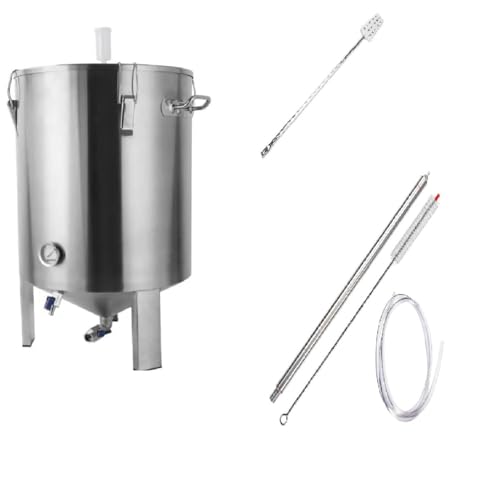
Fermtech 6 Gallon Conical Fermenter
Thirty litre 304 stainless conical supplied with a bottle filler and mash paddle.
Before you do this
A sealed fermenter with no working relief valve, or one that was never designed to be pressurised, can build enough pressure to burst. Only seal and pressurise a vessel with a published pressure rating, watch the gauge, and never defeat or modify the relief valve.
Related on BrewGearCalc
- Keg carbonation calculator
- Keg carbonation reference
- Yeast pitch calculator
- Kegging vs bottling
- More comparisons
Frequently asked questions
- Does pressure fermentation make better beer than a traditional airlock fermenter?
- Not on its own. Pressure fermentation does not change how completely yeast ferments a given wort, so attenuation and alcohol content come out the same either way. What pressure fermentation adds is the ability to transfer finished beer into a keg through a sealed line without exposing it to air, and the ability to ferment some yeast strains warmer without extra fruity flavors. For a beer you bottle, most of that benefit disappears.
- Can I ferment under pressure in a regular fermenting bucket or carboy?
- No. A vessel needs a published pressure rating and a working relief valve to be sealed and pressurised safely. A standard bucket, carboy or unrated stainless conical is built to vent through an airlock, not hold pressure, and sealing one of those without a rated design and a working relief valve can let pressure build to the point of failure. Only use a fermenter specifically built and rated for pressure.
- What is a closed transfer and why does it matter?
- A closed transfer moves beer from a pressure fermenter into a keg through a sealed line, using the fermenter's own pressure to push the beer, with no open air contact at any point. It matters because oxygen picked up after fermentation is one of the most common reasons beer loses hop aroma or goes stale early, and a closed transfer nearly eliminates that exposure entirely.
- Do I need a spunding valve for pressure fermentation?
- A spunding valve, which holds a chosen pressure inside the fermenter, is the standard way to carbonate beer in the vessel and control fermentation pressure precisely. Some pressure fermenters ship with an integrated valve and gauge; check the specific fermenter's published fittings before assuming one is included, since not every pressure rated vessel comes with the same accessories out of the box.
- Is pressure fermentation worth it for a beginner?
- Usually not yet. Pressure fermentation adds cost, a pressure gauge to monitor and a relief valve to manage correctly, on top of everything a beginner is already learning about temperature control and sanitation. A traditional airlock fermenter teaches the fundamentals just as well. Add pressure fermentation once you are kegging regularly and want the closed transfer oxygen benefit it offers.
- Can pressure fermenters burst?
- A pressure rated vessel with a working relief valve, kept within its published pressure limit, is designed to handle that pressure safely. The real risk comes from defeating or blocking the relief valve, or from sealing a vessel that was never rated for pressure in the first place. Always check the gauge, never exceed the published rating, and never modify or disable the relief valve.
Researched from published brewing formulas, manufacturer specifications and verified owner reviews. This is general guidance, not professional advice.