Compare
Mash and Boil vs BrewZilla
The Brewer's Edge Mash and Boil Series 2 with pump is the better value for most home brewers at $437.56, since it adds recirculation for about $162 less than the BrewZilla Gen 4 with a pump at $599.99.
Brewers who want the newest control features or plan to scale batch size up should still look at BrewZilla, but the Mash and Boil line is where the cheaper option is genuinely the smarter buy for a typical five gallon home brewer.

Brewer's Edge Mash & Boil Series 2 with Pump
Brewers Edge
At $437.56 it includes the pump most brewers eventually want, without paying the roughly $162 premium the equivalent pump-equipped BrewZilla Gen 4 carries at $599.99.
Price last checked at publication and changes often.
Same category, different price ladder
Both the Brewer's Edge Mash and Boil and the BrewZilla are single vessel electric all-in-one systems. Grain mashes and wort boils in the same kettle, a control box on the outside manages temperature, and an optional pump recirculates wort or wash water. Neither line asks a brewer to plumb together a separate mash tun and kettle.
Where they differ is the price ladder each brand offers. The Mash and Boil comes in a no-pump Series 2 at $369.95 and a pump-equipped Series 2 at $437.56, a gap of $67.61 for the pump alone. BrewZilla's lineup in this catalog runs from the Gen 3.1.1 at $469.95 up to the Gen 4 at $599.99. A brewer comparing these two brands is really comparing two different price bands, not two versions of one idea.
Brewer's Edge also sells a non-Series 2 Mash and Boil and a Mash and Boil with Pump (7.5 gal) in this catalog, at $369.95 and $439.99 respectively, which sit right alongside the Series 2 pricing. That tells a shopper the Mash and Boil name covers more than one generation of hardware, similar to how BrewZilla covers more than one generation, so matching the exact listing to the exact features matters more than matching just the brand name.
The pump is the real decision inside each brand
Within the Mash and Boil line, the pump is the single biggest functional difference between the two Series 2 listings. Without a pump, a brewer manually stirs and manually transfers wort, which works fine for a five gallon batch but adds hands-on time and some risk of scorching grain against the element if stirring lapses during the mash. With the pump, wort recirculates continuously, which helps even out mash temperature and can improve conversion efficiency without a brewer standing over the kettle the whole time.
BrewZilla follows a similar pattern in this catalog, with a 110V listing and a 110V listing that specifies a pump, both priced at $599.99. That means a buyer choosing BrewZilla should read the exact listing title carefully, since the pump is included in one and not clearly stated in the other, at the identical price point.
A pump also changes how a brewer manages the boil, not just the mash. Recirculating during a boil helps distribute hop additions more evenly through the wort and can reduce the chance of a hot break sticking to the bottom of the vessel near the element. A no-pump unit still produces good beer, but a brewer relies more on manual stirring at each hop addition to get the same even distribution.
How the options compare
| System | Pump included | Price | Basis |
|---|---|---|---|
| Mash and Boil Series 2 (no pump) | No | $369.95 | Standard, from listing |
| Mash and Boil Series 2 (with pump) | Yes | $437.56 | Standard, from listing |
| BrewZilla Gen 3.1.1 | Not specified in this listing | $469.95 | Confirm with retailer |
| BrewZilla Gen 4 (110V, with pump) | Yes | $599.99 | Standard, from listing |
Where the cheaper choice genuinely wins
For a brewer doing standard five gallon batches who has not yet decided how much they care about recirculation, the Mash and Boil Series 2 without a pump at $369.95 is the honest starting point. It is the least expensive route into all-in-one electric brewing across both brands here, and a stir spoon costs a fraction of a pump upgrade if the brewer later decides they want one.
For a brewer who already knows they want a pump, the Mash and Boil Series 2 with pump at $437.56 does the same fundamental job as the pump-equipped BrewZilla Gen 4 at $599.99, for $162.43 less. That gap does not disappear on a shelf; over several batches it is real money that could go toward ingredients, a second fermenter or a kegging setup instead. This is a case where the cheaper option is not a compromise, it is simply the better buy unless a brewer has a specific reason to prefer the BrewZilla name or its published control features.
When BrewZilla is the right call anyway
BrewZilla still makes sense for a brewer planning to scale toward larger batch sizes over time, or one who wants to stay within a single brand's ecosystem of accessories. The BrewZilla Gen 3.1.1 at $469.95 is also worth a look for a buyer who wants something above entry level but is not ready to pay full Gen 4 price, and it undercuts the pump-equipped Gen 4 by $130.04.
Whichever brand a reader picks, the underlying brewing chemistry does not change. Strike water temperature, mash pH and boil-off all follow the same published formulas regardless of which stainless kettle is doing the heating.
A brewer who already owns BrewZilla-specific accessories, such as a fitted grain basket or replacement parts sized for that vessel, also has a practical reason to stay within the BrewZilla lineup rather than switching brands entirely, since accessories rarely cross over between manufacturers.
Batch size and how it shapes the choice
Neither brand publishes a single number here that tells a reader exactly how many finished gallons they will get, since that depends on grain bill size, boil-off rate and how full a brewer is comfortable filling the vessel. What matters practically is thinking in terms of the batch size you actually brew most often, typically five gallons for most home brewers in this catalog's price range, and confirming that the specific listing you are buying, whether Mash and Boil or BrewZilla, comfortably holds that mash plus grain plus headspace before the boil starts.
A brewer who brews in smaller five gallon batches most of the time gets little practical benefit from the largest, most expensive unit in either lineup. The extra capacity mostly matters once a brewer starts routinely pushing toward ten gallon batches or brewing for a group, at which point the higher-capacity end of either brand's range starts to earn its price.
Accessories worth budgeting for either way
Neither the Mash and Boil nor the BrewZilla ships with everything a brew day needs. A hydrometer or refractometer to check gravity, a thermometer if the built-in probe ever needs a second opinion, and a wort chiller to bring the boil down to pitching temperature are all separate purchases regardless of which all-in-one system a brewer picks. Budgeting for these alongside the vessel itself gives a more honest picture of total first-brew-day cost than the sticker price on the kettle alone.
A grain mill is worth the same consideration. Neither line comes with one, and a finer, more consistent crush from a mill like the Ferroday 2 Roller Stainless Grain Mill at $92.90 affects extraction efficiency regardless of which all-in-one system is doing the mashing and boiling.
What goes wrong, and how you notice
The most common failure on either brand is not a dramatic one: mineral scale builds up on the heating element from hard water over repeated batches, and the element gradually heats less efficiently, stretching out how long a strike or a boil takes to reach target temperature. A brewer notices this as a mash or boil that is running noticeably slower than earlier batches on the same recipe, and it is worth a soak in a cleaner before assuming the element itself has failed.
A stuck recirculation pump is the other failure point worth watching for on either the pump-equipped Mash and Boil or a BrewZilla. Grain husks or hop material can clog the pump's inlet screen, which shows up as reduced or stopped flow through the recirculation line during the mash. Checking and clearing that screen is routine maintenance, not a sign the unit is broken.
What this choice locks you into
Whichever line a brewer picks, the vessel size caps the largest batch that system can produce. Both brands sell larger capacity units elsewhere in the market, but within the specific listings in this catalog, a brewer choosing the Mash and Boil or the standard BrewZilla Gen 3.1.1 or Gen 4 is committing to a five to nine gallon range of finished batch sizes, not the ten gallon and up territory some three vessel or larger all-in-one setups reach.
How we chose
These figures come from the published listing prices and features in this catalog, not from a side-by-side brew day. Where a listing does not clearly state whether a pump is included, that ambiguity is called out rather than assumed away.
The three tiers
These are three genuinely different builds, not the same product at three prices. Buy the tier that matches how much you already know you will use it.
Brewer's Edge Mash & Boil Series 2 (no pump)
Brewers Edge
At $369.95 with no pump, this is the least expensive all-in-one option in either brand here, and a fine way to learn all-grain brewing before deciding if recirculation is worth the added cost.
$369.95
View on AmazonBrewer's Edge Mash & Boil Series 2 with Pump
Brewers Edge
At $437.56, adding the pump costs $67.61 over the base Series 2 and delivers the recirculation most brewers eventually want, for $162.43 less than the equivalent pump-equipped BrewZilla Gen 4.
$437.56
View on AmazonBrewZilla Gen 4 (35L, 110V, with pump)
Kegland
At $599.99 with a pump included, this is the most expensive option in this comparison. A brewer who is happy with the Mash and Boil's recirculation and does not specifically want the BrewZilla name or its newest generation of controls should not pay the premium here.
$599.99
View on AmazonEverything else worth considering

BrewZilla Gen 3.1.1 (35L)
The previous generation BrewZilla at a lower price, with the same 35 litre stainless body and step mashing.
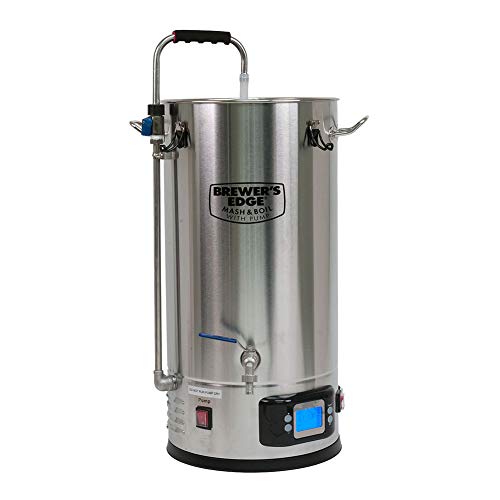
Brewer's Edge Mash and Boil with Pump (7.5 gal)
All-grain electric system with pump, 7.5 gallon capacity, no propane or separate mash tun required.

Brewer's Edge Mash and Boil
The original Mash and Boil, an electric mash tun and kettle in one vessel.
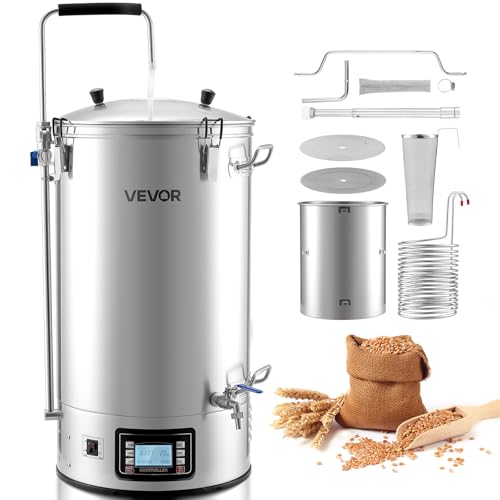
VEVOR 16 Gallon Brewing System (3000W)
Sixteen gallon all-in-one with anti-burn pump and wort chiller, sized for ten gallon batches.
Related on BrewGearCalc
- BrewZilla vs Grainfather
- All-in-one vs three vessel brewing
- Efficiency calculator
- Mash water calculator
- Best brewing gear
Frequently asked questions
- Is the Mash and Boil as good as a BrewZilla?
- Both are single vessel electric all-in-one systems that mash and boil in the same kettle, so the fundamental brewing process is the same. The Mash and Boil Series 2 with pump costs $437.56 against $599.99 for a pump-equipped BrewZilla Gen 4, so for most five gallon home brewers the Mash and Boil delivers the same core function for meaningfully less money.
- Do I need the pump version of the Mash and Boil?
- Not strictly. Without a pump you stir and transfer by hand, which works for a five gallon batch but takes more attention during the mash. The pump version costs $67.61 more at $437.56 and recirculates automatically, which many brewers find worth paying for once they have done a few manual batches and know they want to upgrade.
- What is the price difference between BrewZilla Gen 3.1.1 and Gen 4?
- The BrewZilla Gen 3.1.1 lists at $469.95 and the Gen 4 (110V, with pump) lists at $599.99, a difference of $130.04. Compare the exact features on each listing before paying the premium for the newer generation, since the gap is large enough to also cover other equipment such as a hydrometer, a wort chiller or several batches of ingredients.
- Does the BrewZilla Gen 4 come with a pump automatically?
- This catalog carries both a BrewZilla Gen 4 110V listing and a separate 110V listing that specifies a pump, both at $599.99. Check the exact title of the listing you are buying, since the pump is the functional difference and it is not automatically guaranteed just because the price matches.
- Which is cheaper, Mash and Boil or BrewZilla?
- The Mash and Boil line is cheaper at every comparable tier in this catalog. The no-pump Series 2 is $369.95 against a starting BrewZilla price of $469.95 for the Gen 3.1.1, and the pump-equipped Series 2 at $437.56 undercuts the pump-equipped BrewZilla Gen 4 at $599.99 by $162.43, without giving up recirculation.
- Can I add a pump to the Mash and Boil later instead of buying it now?
- This comparison is based on the two Series 2 listings sold with and without a pump already installed, not on aftermarket pump kits, since specifications for a separate retrofit are not published here. If a pump matters to you, buying the pump-equipped Series 2 at $437.56 up front is the option this catalog can confirm.
Researched from published brewing formulas, manufacturer specifications and verified owner reviews. This is general guidance, not professional advice.