ABV by gravity
ABV for OG 1.065 and FG 1.012
A beer that started at 1.065 and finished at 1.012 is 6.96% ABV by the standard formula and 7.24% by the alternate formula, a difference of 0.28 percentage points.
Apparent attenuation is 81.5%, and a 12 oz serving works out to roughly 217 calories. This is strong.
OG 1.065 to FG 1.012
| Figure | Value | Basis |
|---|---|---|
| ABV, standard formula (OG minus FG) x 131.25 | 6.96% | Standard |
| ABV, alternate formula (alcohol by weight first) | 7.24% | Standard |
| Difference between the two | 0.28 points | Standard |
| Apparent attenuation | 81.5% | Standard |
| Gravity points dropped | 53 | Standard |
| Original extract | 15.9 Plato | Standard |
| Calories per 12 oz | 217 | Standard |
Rows marked Standard come from a published equation, constant or manufacturer specification. Rows marked Convention are widely repeated brewing practice with no governing document behind them. The difference matters, so this site labels it rather than blurring the two together.
Gear for measuring gravity
Prices are those returned when this page was last built and change often.

Brewer's Elite Hydrometer and Test Jar
Triple scale hydrometer with a plastic test jar. Stable gravity on this instrument is the only real proof fermentation has finished.
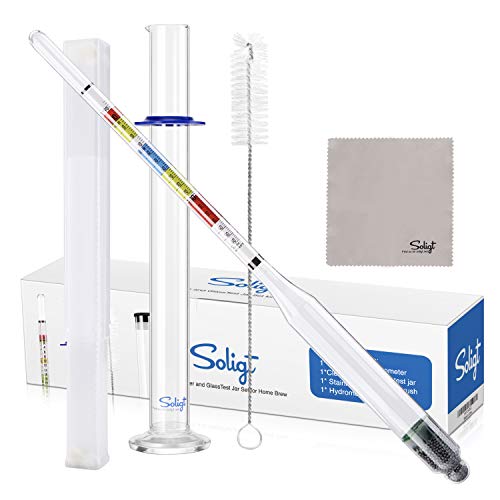
SOLIGT Triple Scale Hydrometer with Glass Test Jar
Hydrometer reading ABV, Brix and specific gravity, supplied with a glass jar.
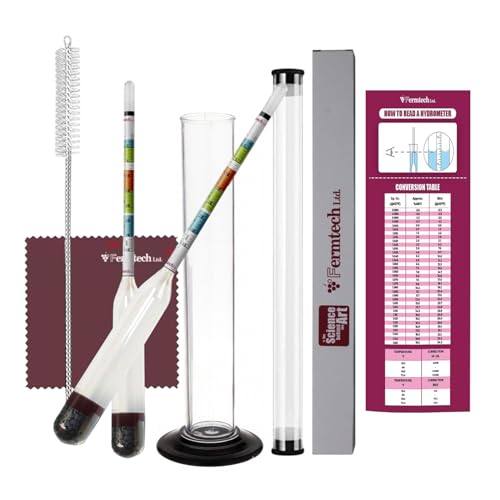
Fermtech Glass Triple Scale Hydrometer Kit
Triple scale glass hydrometer for beer, wine, mead and cider.

Fermentaholics Hydrometer Test Jar
Measuring cylinder for taking a gravity sample without dropping the hydrometer into the fermenter.

Brewing America Glass Hydrometer Test Jar with Brush
Narrow glass flask and cleaning brush, which reads more accurately than a wide vessel.
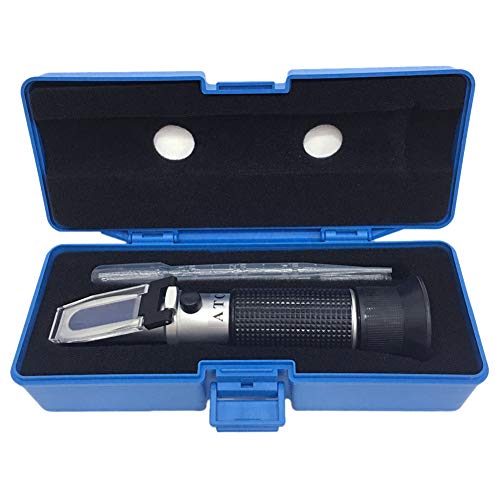
aichose Brix Refractometer with ATC (dual scale)
Dual scale Brix and specific gravity refractometer with automatic temperature compensation, which needs only two drops of wort.

Ade Advanced Optics Beer Wort Refractometer
Dual scale refractometer reading specific gravity 1.000 to 1.120 and Brix, built for wort rather than fruit.

Rhino Beer Refractometer (0 to 32 Brix, ATC)
Brewing specific refractometer covering 0 to 32 Brix and 1.000 to 1.130 gravity with automatic temperature compensation.

LAFMATE Digital Refractometer (0 to 55 Brix)
Digital readout refractometer, which removes the judgement call of reading a blurred line on an optical scale.

Tilt Wireless Hydrometer and Thermometer
A floating sensor that reports gravity and temperature over Bluetooth, so you can confirm stable gravity without opening the fermenter.

Tilt Pro Mini Wireless Hydrometer
The higher resolution Tilt, sized to fit smaller fermenter openings.

Tilt Pico WiFi Adapter
Bluetooth to WiFi bridge that logs a Tilt to the cloud without leaving a phone beside the fermenter.
Related on BrewGearCalc
- ABV calculator Both formulas, on your own numbers
- Hydrometer temperature correction
- Where the two ABV formulas part company
- ABV for OG 1.065 and FG 1.015
- ABV for OG 1.062 and FG 1.015
- ABV for OG 1.068 and FG 1.014
- ABV for OG 1.062 and FG 1.012
- ABV for OG 1.090 and FG 1.020
- ABV for OG 1.048 and FG 1.010
Frequently asked questions
- Which ABV number is correct for OG 1.065 and FG 1.012?
- Both are published and both are used. The standard formula multiplies the gravity drop by 131.25 and gives 6.96%. The alternate formula works out alcohol by weight first and gives 7.24%. At this gravity they differ by 0.28 percentage points. The alternate formula tracks reality better as gravity climbs, so most brewers quote the simple number for ordinary beer and switch to the alternate one for strong beer.
- Why do the two ABV formulas disagree?
- The 131.25 multiplier is a straight line fitted to ordinary strength beer. Fermentation is not linear, so the further a beer moves from that range the more the approximation drifts. The alternate formula derives alcohol by weight and converts it, which holds up better at high gravity. The two agree closely near 5% and separate noticeably above about 8%.
- Does 81.5% attenuation mean the beer is finished?
- Not by itself. Attenuation only describes how far the gravity fell, not whether it has stopped falling. The only real check is a stable reading: take a gravity sample, wait two or three days, take another, and confirm it has not moved. Bottling before that is how bottles burst.
Researched from published brewing formulas, manufacturer specifications and verified owner reviews. This is general guidance, not professional advice.