Charts
Hydrometer Temperature Correction Chart
A hydrometer reading of 1.050 taken at 80F with a hydrometer calibrated at 60F corrects to approximately 1.0524, about 2.4 gravity points higher than the number on the stem.
As a rule, a sample warmer than the calibration temperature always reads low and corrects upward, and a sample colder than the calibration temperature always reads high and corrects downward.
Why hydrometer readings shift with temperature
A hydrometer measures the density of the liquid it is floating in, and density changes with temperature. Water and wort both expand slightly as they warm, becoming less dense, so the same batch will show a different number on the stem depending on how warm or cold the sample happens to be when you read it. The scale printed on a hydrometer is only exactly accurate at one reference temperature, the temperature the instrument was calibrated against.
For most home brewing hydrometers that reference temperature is 60F, though it is not universal, and some instruments are calibrated at 68F or at 20C instead. The reference temperature is the entire basis of any correction, so the first step in reading a hydrometer correctly is finding the calibration temperature stamped on the stem, printed on the box, or listed in the product manual, rather than assuming 60F applies to every hydrometer on the market.
Because the density of water and wort does not change in a straight line across a wide temperature range, brewers rely on a published density correction rather than a hand-waved guess. This is standard: a polynomial built from measured density behavior gives the actual specific gravity once you know both the reading and the sample temperature, and it is the same math this site uses in its own hydrometer correction calculator.
The practical upshot holds even before anyone opens a chart. A sample pulled warm, straight out of an active fermenter or a cooling wort kettle, will always read lower than the true gravity, because warm liquid is less dense than the cooled reference the hydrometer was calibrated against. A sample pulled cold, out of a refrigerator or a cellar in cold weather, will always read higher than the true gravity, because cold liquid is denser than the reference. The correction simply moves the number in the opposite direction of that error.
Which way the correction goes
- Warm sample, low raw reading, correct the number upward.
- Cold sample, high raw reading, correct the number downward.
- The farther the sample sits from the calibration temperature, the bigger the correction, and the relationship is not linear because the underlying density curve of water and wort is not a straight line.
| Sample condition | What the raw reading does | Correction direction | Approximate size |
|---|---|---|---|
| At the calibration temperature (commonly 60F) | Reads accurately, no error | None needed | Zero |
| A few degrees warmer (65 to 70F) | Reads slightly low | Correct upward | Small, often well under a full point |
| Well warmer (75 to 85F) | Reads noticeably low | Correct upward | A few gravity points, see the worked example below |
| Far warmer (90F and above) | Reads well below the true gravity | Correct upward | Larger, and it grows faster than the temperature gap alone suggests |
| A few degrees colder (50 to 55F) | Reads slightly high | Correct downward | Small |
| Well colder (40F or below) | Reads above the true gravity | Correct downward | Moderate to larger |
A worked example from the published correction
A reading of 1.050 taken at 80F, with a hydrometer calibrated at 60F, corrects to approximately 1.0524. That means the true gravity of the sample is about 2.4 points higher than what the stem shows at that temperature. This figure comes directly from the standard density correction, not from a rule of thumb, and it shows how much error a 20 degree gap between sample temperature and calibration temperature can introduce into a reading that otherwise looks precise to three decimal places.
It is tempting to want a single printed table that covers every combination of starting gravity and sample temperature, but that table would either have to be enormous or would have to round so aggressively that it stopped being trustworthy. The size of the correction depends on both the temperature gap and the starting gravity itself, and a flat number per temperature band can be off by a meaningful fraction of a point at the extremes. The reliable way to correct any specific reading is to run the actual formula for that exact reading and temperature, which is what a hydrometer correction calculator does, rather than eyeballing a position between two rows of a printed grid.
What a chart like this one is good for is teaching the shape of the relationship: which direction the correction goes, that it grows faster than the raw temperature gap implies, and roughly how big a correction to expect at a given distance from calibration. Treat the 80F to 60F, 1.050 example as the one number here you can rely on to the decimal, and treat everything else on this page as the qualitative pattern that number illustrates.
| Reading temperature | Calibration temperature | Raw reading | Corrected reading | Points added |
|---|---|---|---|---|
| 80F | 60F | 1.050 | 1.0524 | +2.4 |
Not every hydrometer is calibrated the same way
Some triple scale hydrometers sold for home brewing are calibrated at 68F rather than 60F, and European instruments are often calibrated at 20C, which is close to 68F but not identical to either US figure. Using a 60F based correction on a hydrometer that was actually calibrated at 68F introduces a small but real error of its own, on top of whatever the sample temperature is doing. The fix is simply to read the stem or the packaging before assuming anything, and to use the calibration temperature that instrument actually specifies as the reference point.
This matters most for brewers who own more than one hydrometer, such as a cheap glass unit for quick checks and a more expensive triple scale unit for finished gravity, because the two may not share a calibration point. Mixing up which reference applies to which instrument is a common, easy to miss source of gravity readings that do not agree with each other even when both were read carefully.
Getting a clean reading in the first place
Temperature correction only fixes a known, predictable error. It does nothing for the other common mistakes that show up in a hydrometer sample, and those are worth ruling out first because they can be larger than the temperature effect itself. Reading the meniscus from above or below eye level rather than straight on introduces parallax error that has nothing to do with temperature. Air bubbles clinging to the glass or to the hydrometer body itself can lift a reading enough to matter, especially right after a vigorous fermentation. A dirty or residue coated hydrometer can also read incorrectly regardless of temperature.
A cheap digital thermometer next to the test jar removes the guesswork of estimating sample temperature by feel, and it is a small investment relative to the cost of a batch. Pairing a thermometer with a hydrometer and test jar is the simplest way to get a correction that is actually based on the real sample temperature rather than an assumption about room temperature.
- Cool a hot sample toward the calibration temperature before reading when practical, since a smaller gap means a smaller correction and less room for error.
- Read the meniscus at eye level, at the bottom of the curve the liquid forms against the glass.
- Tap or spin the hydrometer gently to dislodge bubbles before taking the reading.
- Rinse the test jar and hydrometer between uses so residue does not affect buoyancy.
Everything else worth considering

Brewer's Elite Hydrometer and Test Jar
Triple scale hydrometer with a plastic test jar. Stable gravity on this instrument is the only real proof fermentation has finished.
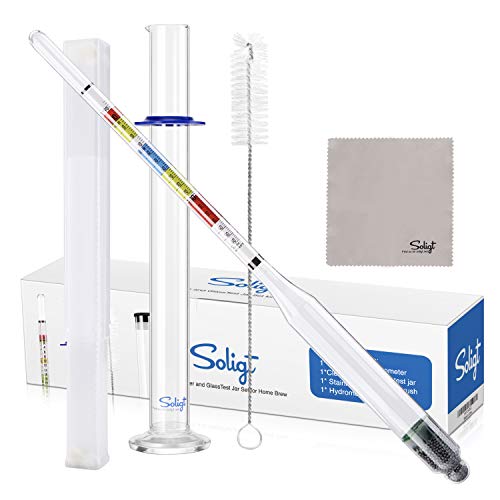
SOLIGT Triple Scale Hydrometer with Glass Test Jar
Hydrometer reading ABV, Brix and specific gravity, supplied with a glass jar.
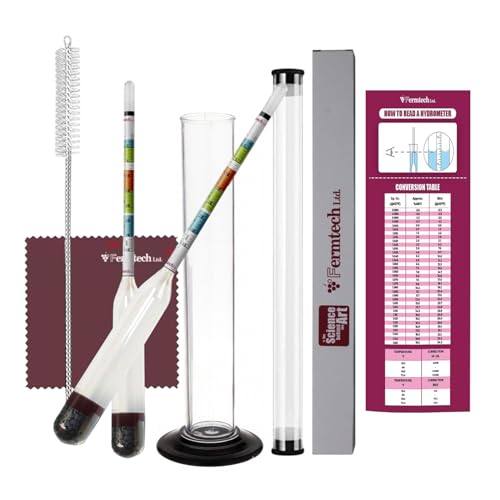
Fermtech Glass Triple Scale Hydrometer Kit
Triple scale glass hydrometer for beer, wine, mead and cider.

Fermentaholics Hydrometer Test Jar
Measuring cylinder for taking a gravity sample without dropping the hydrometer into the fermenter.

Brewing America Glass Hydrometer Test Jar with Brush
Narrow glass flask and cleaning brush, which reads more accurately than a wide vessel.

CDN Waterproof Digital Thermometer (4.75 inch stem)
NSF certified waterproof thermometer with a long stem, which reaches into a mash without soaking the housing.

OXO Good Grips Digital Instant Read Thermometer
Fast reading digital thermometer for checking strike and mash temperature.

Tilt Wireless Hydrometer and Thermometer
A floating sensor that reports gravity and temperature over Bluetooth, so you can confirm stable gravity without opening the fermenter.

Tilt Pro Mini Wireless Hydrometer
The higher resolution Tilt, sized to fit smaller fermenter openings.
Related on BrewGearCalc
- Hydrometer correction calculator
- Refractometer calculator
- ABV calculator
- Equipment specs
- Reference charts
Frequently asked questions
- Do I need to correct every single hydrometer reading I take?
- Only when the sample is not at the calibration temperature stamped on your hydrometer, which is often 60F. If you consistently cool samples to that exact temperature before reading, no correction is needed. Most brewers do not bother controlling temperature that precisely, so a quick check of the sample temperature and a correction pass, especially on readings taken warm from an active fermentation, keeps the numbers you record accurate and comparable batch to batch.
- Why does my hydrometer read differently right after the boil compared to after the wort has cooled?
- Hot wort is less dense than cool wort, so a hydrometer floats lower in a hot sample and shows a lower gravity than the wort actually has. This is the same temperature effect that applies during fermentation, just at a more extreme temperature. Waiting for the sample to cool closer to your hydrometer calibration temperature, or applying the correction for the actual sample temperature, gives you the real starting gravity instead of an artificially low number.
- Is the correction the same size for a light reading like 1.010 as for a strong reading like 1.070?
- No. The correction depends on both the temperature gap and the density of the liquid itself, so the exact number of points added or subtracted is not identical across different starting gravities even at the same temperature gap. The direction of the correction, warm reads low and corrects up, cold reads high and corrects down, stays the same regardless of the starting gravity, but only a calculator run against the specific reading gives an exact corrected value.
- My hydrometer is marked 68F instead of 60F. Does a 60F based chart still apply to it?
- The direction of the correction still applies, but the reference point does not. A 68F calibrated hydrometer reads accurately at 68F, not at 60F, so treating it as a 60F instrument introduces an error before temperature is even considered. Always correct against the calibration temperature printed on your specific hydrometer, not against whichever reference temperature happens to be most commonly discussed online.
- Can I just always take readings at room temperature and skip correction entirely?
- Only if your room temperature happens to match your hydrometer calibration temperature, which is a coincidence rather than something to rely on. Most homes run somewhere in the high 60s to low 70s F, which is close to a 60F reference but not exact, so a small correction is still technically appropriate even at typical room temperature. The gap is usually small enough that skipping it will not ruin a beer, but it will make gravity readings less precise.
- Does a refractometer need this same kind of temperature correction?
- Refractometers use their own correction, typically an automatic temperature compensation built into the optics plus a separate wort correction factor once alcohol is present, and that is a different mechanism from the thermal expansion correction that applies to a hydrometer. Do not apply a hydrometer temperature correction to a refractometer reading. A refractometer calculator handles that instrument's own correction requirements separately.
Researched from published brewing formulas, manufacturer specifications and verified owner reviews. This is general guidance, not professional advice.