Mash and sparge volumes
Mash and sparge water for a 10 gallon batch with 16 lb of grain
A 10 gallon batch with 16 lb of grain needs about 5 gallons of strike water and 8.25 gallons of sparge water, 13.25 gallons in total.
That assumes a one hour boil losing 1 gallon per hour and grain absorbing 0.125 gallons per pound. Absorption and boil-off are conventions that vary by system, so measure your own once and the numbers get much better.
10 gallon batch, 16 lb grain, 1.25 qt/lb
| Quantity | Gallons | Basis |
|---|---|---|
| Strike water into the mash | 5 | Standard |
| Sparge water | 8.25 | Standard |
| Total water needed | 13.25 | Standard |
| Pre-boil volume | 11.25 | Standard |
| Absorbed by the grain | 2 | Convention |
| Lost to boil-off | 1 | Convention |
Rows marked Standard come from a published equation, constant or manufacturer specification. Rows marked Convention are widely repeated brewing practice with no governing document behind them. The difference matters, so this site labels it rather than blurring the two together.
Mash tuns and kettles
Prices are those returned when this page was last built and change often.
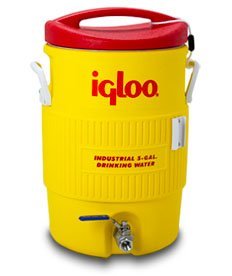
Learn To Brew 10 Gallon Igloo Mash Tun
Insulated cooler mash tun with a stainless false bottom and valve, which holds mash temperature without any power.

Quick Fit 10 Gallon Igloo Mash Tun with Dial Thermometer
Cooler mash tun with stainless false bottom, stainless valve and a three inch dial probe thermometer.

TAPCRAFT Cooler Mash Tun Conversion Kit
False bottom, full port ball valve and gaskets to convert a drinks cooler you already own into a mash tun.
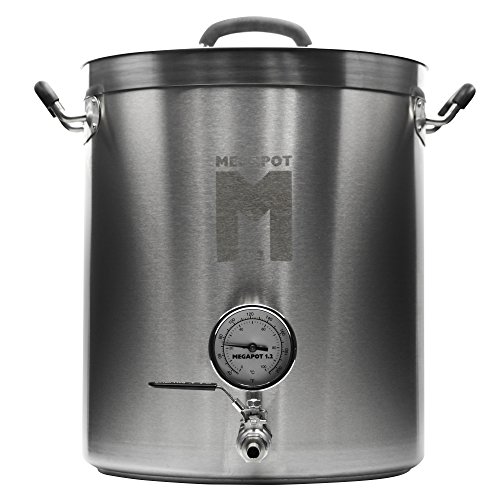
Northern Brewer MegaPot 10 Gallon (valve and thermometer)
Heavy stainless kettle with volume markings, a ball valve and a fitted thermometer, for propane or electric element brewing.

Northern Brewer MegaPot 10 Gallon (valve)
The same MegaPot body with a ball valve but no thermometer port fitted.

Concord 10 Gallon Brew Kettle (weldless fittings)
Forty quart stainless stock pot supplied with weldless valve and thermometer fittings.

MRbrew 10 Gallon Brew Kettle with Thermometer
Budget ten gallon stainless kettle with a built-in thermometer.
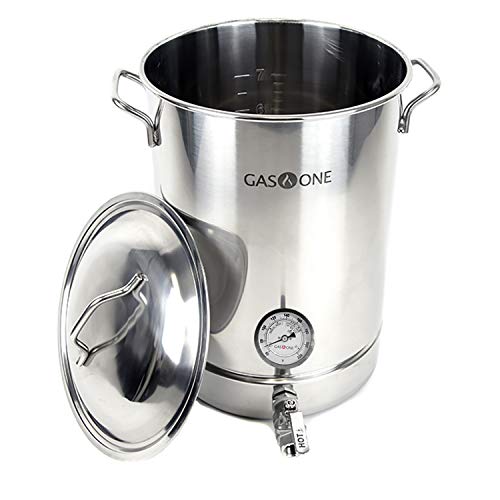
Gas One 8 Gallon Brew Kettle (4 piece set)
Pre-drilled 32 quart tri-ply bottom kettle sold as a four piece set.

VEVOR 16 Gallon Brew Kettle with Filter
Large stainless kettle with a filter and filter tube, for ten gallon batches on a burner.

BrewZilla Gen 4 (35L, 110V, with pump)
Wifi and RAPT integrated 35 litre all-in-one with a recirculation pump and automatic step mashing, on standard US household power.
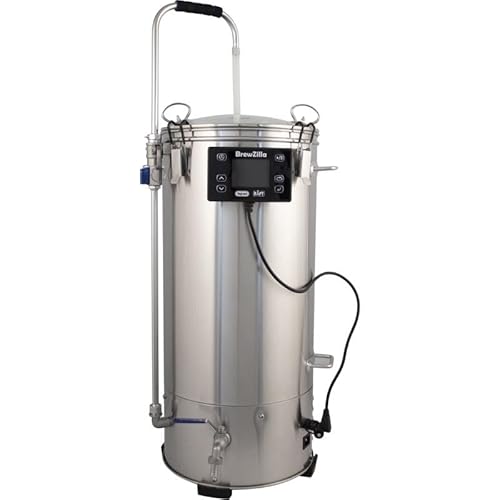
BrewZilla Gen 4 35L (110V)
The 110V Gen 4 BrewZilla: stainless construction, automatic step mashing, nine gallon capacity.

BrewZilla Gen 3.1.1 (35L)
The previous generation BrewZilla at a lower price, with the same 35 litre stainless body and step mashing.

Brewer's Edge Mash & Boil Series 2 with Pump
Programmable electric all-in-one kettle with a recirculation pump, sized for five gallon batches.
Related on BrewGearCalc
- Mash and sparge water calculator
- Strike water calculator
- Boil-off rate calculator
- Mash water at 1 quarts per pound for an 11 lb grain bill
- Mash and sparge water for a 10 gallon batch with 14 lb of grain
- Mash water at 1.25 quarts per pound for an 11 lb grain bill
- Mash and sparge water for a 10 gallon batch with 12 lb of grain
- Mash water at 2.25 quarts per pound for an 11 lb grain bill
- Mash and sparge water for a 5 gallon batch with 14 lb of grain
Frequently asked questions
- How much sparge water for 16 lb of grain in a 10 gallon batch?
- About 8.25 gallons, once the mash has taken 5 gallons and the grain has absorbed roughly 2 gallons. Total water for the brew day is around 13.25 gallons. Sparge volume is whatever is left after the mash, so it changes every time your grain bill does.
- Why does grain absorption matter so much?
- Because it is water you never get back. At roughly 0.125 gallons per pound, 16 pounds of grain keeps about 2 gallons in the spent grain. Brewers who ignore it consistently finish short of their target volume and end up with a stronger, smaller batch than the recipe intended.
- Is 1.25 quarts per pound the right mash thickness?
- It is the common default rather than a rule. Thicker mashes around 1 quart per pound hold temperature better and favour body. Thinner mashes near 2 quarts per pound convert a little more efficiently and are easier to stir. Anything from about 1 to 2 quarts per pound makes beer.
Researched from published brewing formulas, manufacturer specifications and verified owner reviews. This is general guidance, not professional advice.