Compare
PBW vs Oxygen Cleaners
Five Star PBW, sold here from $8.98 for a twelve-count tablet pack up to $59.99 for a two-pack of 4 lb tubs, is the cleaner this catalog actually carries. A plain oxygen-based cleaner, the kind of unscented household product many brewers reach for as a lower-cost substitute, is not carried as a separate product in this catalog, so every recommendation on this page is a PBW format.
Cleaning and sanitising are different jobs. PBW's role ends once organic residue and film are removed; a separate sanitiser step still has to follow before the equipment touches beer.

Five Star PBW Cleanser (4 lb)
Five Star
A 4 lb tub covers many cleaning sessions at a lower per-use cost than the 1 lb size or the tablets, without committing to the bulk two-pack that most home brewers do not need.
Price last checked at publication and changes often.
What PBW actually is
Five Star's Powdered Brewery Wash is an alkaline, phosphate-free cleaner formulated specifically to strip proteins, hop residue, and general organic film from brewing equipment without scratching plastic or dulling stainless steel. That phosphate-free claim is a published manufacturer specification, not a marketing guess, and it is part of why the product is aimed squarely at brewing equipment rather than general household cleaning.
PBW is a cleaner, not a sanitiser. Its job is to remove residue that a sanitiser cannot see through, and once that residue is gone and the equipment is rinsed, a separate sanitising step, such as Star San, is what actually protects against contamination before the next batch touches that equipment.
What an oxygen-based cleaner is, and why brewers reach for one
A plain oxygen-based cleaner works by releasing an oxidizing agent, commonly sodium percarbonate, once dissolved in water, breaking down organic residue in a broadly similar way to how PBW's alkaline formulation works. Many home brewers report using an unscented, dye-free household version of this kind of cleaner as a lower-cost substitute for PBW, since the two act on residue through a comparable mechanism.
That substitution is a widely repeated home brewing convention, not a claim published by Five Star, and the two products are not marketed as identical formulations. A plain oxygen cleaner does not include whatever additional surfactants or chelating agents PBW's specific formulation carries, and this catalog does not carry a plain oxygen cleaner as a separate SKU to compare directly against PBW.
The genuine gap in this catalog
Every cleaner key verified in this catalog's cleaning section is a PBW format: powder, liquid, or tablets. There is no plain, brand-neutral oxygen cleaner carried here as its own product. That is worth stating plainly rather than pretending one of the PBW listings is somehow the same thing as a generic oxygen cleaner, since they are not identical products even if they work on residue in a similar way.
A brewer who specifically wants to try a plain oxygen cleaner as a lower-cost substitute will need to source it from a general retailer rather than this catalog. Every recommendation below sticks to what is actually stocked here.
Choosing a PBW format: powder, liquid, or tablets
PBW powder, sold in 1 lb and 4 lb sizes, is mixed to a working concentration in water according to the label and is the most economical way to buy PBW per use, especially at the 4 lb size. PBW Liquid skips the powder measuring step entirely, a convenience for someone who dislikes scooping and dissolving powder, at a higher per-use cost than the equivalent amount of powder.
PBW Tablets are pre-measured single doses, useful for spot cleaning a single small item like an airlock, a length of tubing, or a bottle filler without mixing up a full batch of solution for one small job. The 4 lb two-pack is a bulk option aimed at heavy or shared use rather than a typical single-fermenter home setup, and the Star San and PBW bundle pairs a cleaner with a sanitiser for someone starting a kit from zero.
Cleaning is not sanitising, and the two steps cannot be combined
A sanitiser applied to a surface that is not already clean does not work, because organic residue shields microorganisms from a sanitiser's contact. PBW's entire job is to remove that residue so a following sanitiser step actually has a chance to do its job on a genuinely clean surface.
Trying to save time by treating a cleaning pass as if it also sanitises, or the reverse, skipping cleaning and going straight to a sanitiser because equipment looks mostly clean, is one of the more common contamination mistakes in home brewing, and it looks, from the outside, exactly like a sanitiser that simply failed to work.
Handling an alkaline cleaner safely
PBW is marketed as easier on skin than a stronger caustic cleaner, but published safety information for a concentrated alkaline solution still calls for gloves and eye protection, since prolonged or repeated skin contact with a working concentration can still cause irritation. Rinse hands and skin promptly if a concentrated solution makes direct contact.
PBW must never be mixed directly with an acid sanitiser such as Star San. The reaction between a strong alkaline cleaner and an acid sanitiser can produce heat and irritating fumes, and either product on its own is already something to handle carefully at full strength.
Soaking versus spraying, and when each makes sense
A full soak, filling a fermenter or bucket with a mixed PBW solution and letting it sit, is the most thorough way to clean equipment with a lot of interior surface area or stubborn dried residue built up over a longer stretch between cleanings. A spray application works better for equipment that cannot practically be filled and soaked, such as a kettle rinsed promptly after use or a length of tubing run through with solution rather than submerged.
Warm water generally speeds up how effectively PBW's alkaline chemistry breaks down residue compared to cold water, though very hot water is not necessary and can be harder to handle safely around a concentrated cleaning solution.
When paying for PBW specifically is worth it over a substitute
A brewer who already keeps a plain oxygen cleaner on hand for household use has a reasonable case for trying it on brewing equipment as a lower-cost option, understanding that it is not a formulation Five Star has published as equivalent. A brewer who wants a single product purpose-built and marketed specifically for brewing equipment, with published phosphate-free and non-caustic claims backing it, has a reasonable case for sticking with PBW instead and not troubleshooting formulation differences later.
Neither choice is wrong. The decision mostly comes down to whether saving a modest amount per cleaning session is worth using a product that is not specifically formulated or published for brewing equipment, against buying one that is.
How the options compare
| Product / type | Chemistry | Format | Price in this catalog |
|---|---|---|---|
| Five Star PBW (1 lb) | Alkaline, phosphate-free | Powder | $11.97 |
| Five Star PBW (4 lb) | Alkaline, phosphate-free | Powder | $30.99 |
| Five Star PBW Liquid | Alkaline, phosphate-free | Liquid | $26.95 |
| Five Star PBW Tablets | Alkaline, phosphate-free | Pre-measured tablets | $8.98 |
| Plain oxygen-based cleaner | Oxidizing agent, commonly sodium percarbonate | Powder | Not carried in this catalog |
Rinsing thoroughly before the next step
PBW's own instructions call for a thorough rinse with plain water after the cleaning contact time has passed, and skipping or shortening that rinse leaves cleaner residue behind that can interfere with a following sanitiser step or, in a worst case, carry a faint off-flavor into the next batch. A visual check for foam or cloudiness in the rinse water is a simple way to judge whether more rinsing is needed before moving on.
Equipment with tight seams, gaskets, or threaded fittings deserves extra attention during rinsing, since cleaner solution can sit trapped in those spots longer than it does on an open, flat surface, and a incomplete rinse there is a common source of a sanitiser step that seems to fail for no obvious reason.
How we chose
This recommendation comes from published PBW formulation claims and verified owner reviews describing cleaning results on stainless, plastic, and glass equipment. This is not the result of personal hands-on cleaning with these specific products. Because no plain oxygen cleaner is a verified key in this catalog, that entire category is described here rather than recommended by name.
The three tiers
These are three genuinely different builds, not the same product at three prices. Buy the tier that matches how much you already know you will use it.
Five Star PBW Tablets (12 count)
Five Star
At $8.98 for twelve tablets, there is no scooping or mixing math involved, a straightforward first purchase for spot cleaning small items like an airlock or a length of tubing.
$8.98
View on AmazonFive Star PBW Cleanser (4 lb)
Five Star
At $30.99 it covers many full cleaning sessions at a lower per-use cost than the 1 lb size or the tablets, the sensible choice once cleaning a full set of gear after every batch becomes routine.
$30.99
View on AmazonFive Star PBW 4 lb (2 pack)
Five Star
At $59.99 two 4 lb tubs make sense for a shared setup or someone cycling through multiple fermenters at once and cleaning frequently. Someone brewing a handful of batches a year should not buy this; a smaller container gets used up before a long stretch between uses lets powder clump from ambient humidity.
$59.99
View on AmazonEverything else worth considering
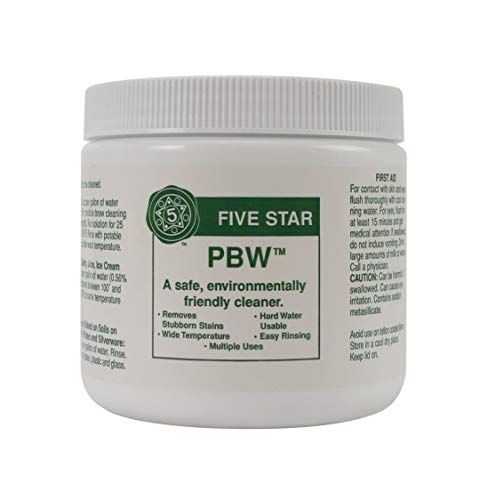
Five Star PBW (1 lb)
Non-caustic alkaline brewery wash that lifts baked-on trub without scrubbing. It is still an alkaline cleaner and needs gloves and eye protection.

Five Star PBW Liquid (32 oz)
Liquid PBW, which dissolves instantly instead of needing warm water to go into solution.

Star San 32 oz and PBW 1 lb Bundle
The cleaner and the sanitiser together, which is the pair every brewer needs and beginners often confuse.
Before you do this
PBW and other alkaline cleaners burn skin and eyes and must never be mixed with acid sanitisers such as Star San. Gloves and eye protection are worth using at working concentration, and a cleaner must be rinsed completely off equipment before a sanitiser is applied, since sanitising a surface that is not already clean does not work.
Related on BrewGearCalc
Frequently asked questions
- Can I use a plain oxygen cleaner instead of PBW?
- Many home brewers report success substituting an unscented, dye-free oxygen-based cleaner for PBW, since both work on organic residue through a broadly similar mechanism. The two are not published as identical formulations, and PBW may include additional surfactants or chelating agents a plain oxygen cleaner does not. This catalog only carries PBW, so that substitution is not something these specific listings confirm directly.
- Does this catalog sell a plain oxygen cleaner?
- No. Every cleaner key verified in this catalog's cleaning section is a Five Star PBW format: powder, liquid, or pre-measured tablets. There is no brand-neutral oxygen cleaner carried here as its own product, and that gap is stated plainly rather than treating one of the PBW listings as an equivalent substitute.
- Is PBW safe on stainless steel and plastic brewing equipment?
- Yes, PBW is formulated specifically to be non-caustic and phosphate-free, marketed as safe for stainless steel and plastic without scratching or dulling either surface. It still deserves the same basic handling care as any concentrated cleaner: gloves and eye protection at working concentration, and a full rinse with plain water before the equipment is used again.
- Do I need to rinse PBW off before sanitising?
- Yes. A sanitiser applied on top of leftover cleaner residue does not work as intended, and leftover PBW residue can also interact with an acid sanitiser like Star San if the two make direct contact. Rinse equipment thoroughly with plain water after cleaning with PBW, and only then move on to the sanitising step.
- What's the difference between PBW powder, liquid, and tablets?
- All three use the same core PBW chemistry. Powder is mixed to a working concentration by hand and is the most economical per use, especially at the 4 lb size. Liquid skips the measuring and dissolving step for convenience at a higher per-use cost. Tablets are pre-measured single doses, best for spot cleaning one small item rather than a full batch of gear.
- Can I mix PBW with Star San in the same bucket?
- No, never combine an alkaline cleaner like PBW with an acid sanitiser like Star San directly. The reaction can produce heat and irritating fumes, and either product alone can already burn skin and eyes at working concentration. Always rinse PBW completely off with plain water first, and keep the two products in separate containers at all times.
Researched from published brewing formulas, manufacturer specifications and verified owner reviews. This is general guidance, not professional advice.