Calculator
Dilution and Blending Calculator
For when the wort came out stronger than the recipe intended.
Dilution works on gravity points, because the total sugar stays the same while the volume grows. Note that it dilutes EVERYTHING in the same proportion, not just sugar: bitterness, colour and mineral content all drop by the same percentage, so a hop schedule designed for the stronger wort will taste noticeably softer afterwards. You cannot dilute upward, and this calculator returns no answer rather than a nonsense one if you try.
The formula
Dilution works on gravity points, because the total sugar stays the same while the volume grows. Note that it dilutes EVERYTHING in the same proportion, not just sugar: bitterness, colour and mineral content all drop by the same percentage, so a hop schedule designed for the stronger wort will taste noticeably softer afterwards. You cannot dilute upward, and this calculator returns no answer rather than a nonsense one if you try.
What rests on a standard and what rests on convention
- Standard Gravity point balance arithmetic.
A standard is a published equation, a published constant or a manufacturer specification. A convention is widely repeated brewing practice with no governing document behind it. Both are useful. Confusing one for the other is how a habit ends up being quoted as a fact.
Measuring and volume gear
This grid re-orders itself against the numbers you enter above. Prices are those returned when the page was built and change often.

Brewer's Elite Hydrometer and Test Jar
Triple scale hydrometer with a plastic test jar. Stable gravity on this instrument is the only real proof fermentation has finished.
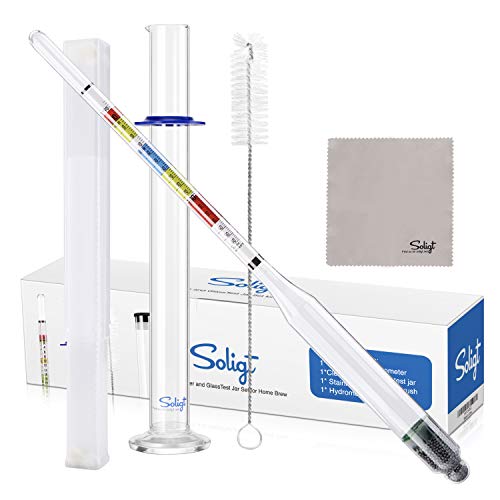
SOLIGT Triple Scale Hydrometer with Glass Test Jar
Hydrometer reading ABV, Brix and specific gravity, supplied with a glass jar.
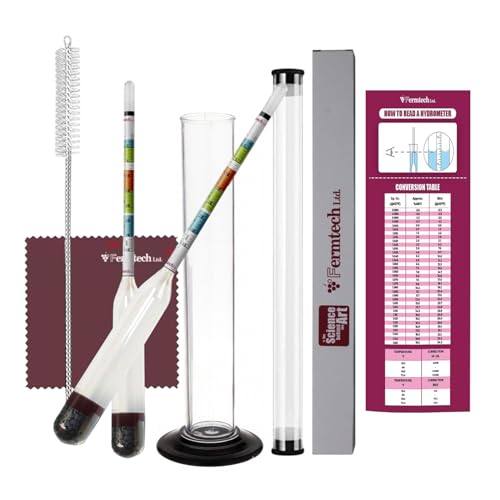
Fermtech Glass Triple Scale Hydrometer Kit
Triple scale glass hydrometer for beer, wine, mead and cider.

Fermentaholics Hydrometer Test Jar
Measuring cylinder for taking a gravity sample without dropping the hydrometer into the fermenter.

Brewing America Glass Hydrometer Test Jar with Brush
Narrow glass flask and cleaning brush, which reads more accurately than a wide vessel.
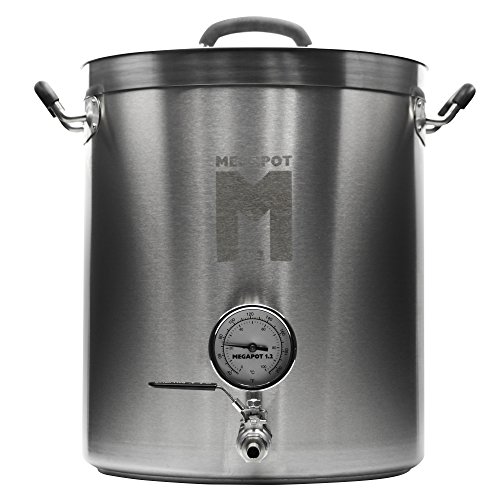
Northern Brewer MegaPot 10 Gallon (valve and thermometer)
Heavy stainless kettle with volume markings, a ball valve and a fitted thermometer, for propane or electric element brewing.

Northern Brewer MegaPot 10 Gallon (valve)
The same MegaPot body with a ball valve but no thermometer port fitted.

Concord 10 Gallon Brew Kettle (weldless fittings)
Forty quart stainless stock pot supplied with weldless valve and thermometer fittings.

MRbrew 10 Gallon Brew Kettle with Thermometer
Budget ten gallon stainless kettle with a built-in thermometer.
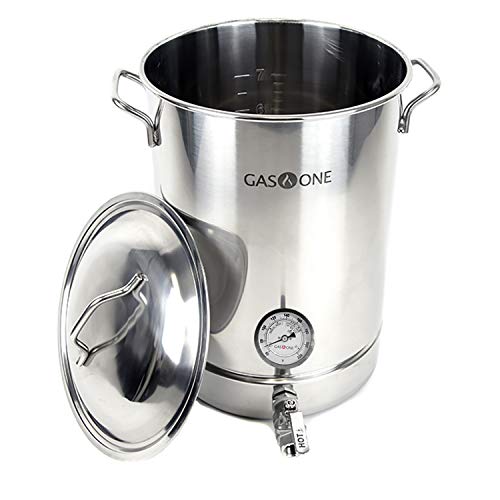
Gas One 8 Gallon Brew Kettle (4 piece set)
Pre-drilled 32 quart tri-ply bottom kettle sold as a four piece set.

VEVOR 16 Gallon Brew Kettle with Filter
Large stainless kettle with a filter and filter tube, for ten gallon batches on a burner.
Related on BrewGearCalc
Frequently asked questions
- Does the dilution water need to be boiled?
- If it goes into cooled wort or into the fermenter, yes. Anything added after the boil is a route for contamination, so boil and chill it first or use water you know to be sterile. Water added before or during the boil needs no separate treatment, because the boil deals with it along with everything else.
- What else changes when I dilute?
- Everything dissolved, proportionally. Bitterness falls by the same percentage as gravity, so a beer diluted by ten percent loses roughly ten percent of its IBU. Colour lightens and the mineral profile of your water thins out too. If you plan to dilute, it is better to design the hop schedule around the final volume rather than the concentrated one.
- Can I raise gravity instead of lowering it?
- Not by dilution, which is why this calculator refuses that input rather than returning something meaningless. To raise gravity you either boil longer to evaporate water, which concentrates everything, or add fermentable sugar or extract. Boiling longer also concentrates bitterness and darkens the wort, so it is not a neutral operation.
Researched from published brewing formulas, manufacturer specifications and verified owner reviews. This is general guidance, not professional advice.