Best Gear
Best Electric Brewing Systems
The BrewZilla Gen 3.1.1 (35L) at $469.95 is the best electric brewing system for most home brewers, giving digital temperature control and a full volume boil without paying for the pump equipped Gen 4.
Brewers on a shared household circuit should start smaller with the VEVOR 8 Gallon Home Beer Brewer (1500W) at $149.90, since its lower wattage draws less current than the larger electric units in this catalog.

BrewZilla Gen 3.1.1 (35L)
Kegland
It gives a full 35 liter volume and a digital controller for precise strike and mash temperatures at $469.95, without the added draw of the Gen 4's pump for brewers who do not need recirculation.
Price last checked at publication and changes often.
What makes electric different from a propane setup
An electric brewing system replaces an open flame with a heating element controlled by a thermostat or digital controller. That trade brings two practical advantages: you can brew indoors somewhere with a standard outlet, and temperature holds steady on a set point instead of drifting the way a hand adjusted flame can.
The trade-off is electrical capacity. Every electric system draws current from whatever circuit it is plugged into, and a standard US household circuit is commonly rated around 15 to 20 amps shared with everything else on that circuit, including lights and other appliances. A higher wattage heating element heats water faster, but it also draws more current, so the practical ceiling on an electric system is often your home's wiring, not the unit itself.
This is why an electric system roundup looks at wattage and voltage as the primary spec, ahead of overall capacity. Two systems with the same size kettle can behave very differently on brew day if one draws twice the current of the other.
How we chose
The wattage, voltage, capacity and pump details below come directly from the manufacturer specifications published on each listing, cross checked against verified purchase owner reviews describing real world heat-up times and any issues drawing power on a shared circuit. This is not a hands on lab test of amperage draw performed by this team; it is a synthesis of what the manufacturers state and what verified owners report after buying and using these systems themselves.
How the electric options compare
Only two listings in this catalog state a wattage figure directly: the VEVOR 8 Gallon Home Beer Brewer at 1500W and the VEVOR 16 Gallon Brewing System at 3000W. The rest are compared by capacity, pump inclusion and price as published, since wattage is not listed on those specific product pages.
| System | Pump included | Price | Catalog tier |
|---|---|---|---|
| VEVOR 8 Gallon Home Beer Brewer (1500W) | No | $149.90 | Beginner |
| VEVOR 16 Gallon Brewing System (3000W) | No | $273.30 | Intermediate |
| Brewer's Edge Mash & Boil Series 2 (no pump) | No | $369.95 | Beginner |
| Brewer's Edge Mash & Boil Series 2 with Pump | Yes | $437.56 | Intermediate |
| BrewZilla Gen 3.1.1 (35L) | No | $469.95 | Intermediate |
| BrewZilla Gen 4 (35L, 110V, with pump) | Yes | $599.99 | Expert |
Sizing an electric system to your circuit and your batch
For a first electric system, the VEVOR 8 Gallon Home Beer Brewer at $149.90 keeps wattage low at 1500W, which draws less current than the larger units in this catalog and is a safer bet on a shared household circuit. The trade-off is a longer heat-up time to reach strike and boiling temperatures compared to a higher wattage unit.
The Brewer's Edge Mash & Boil Series 2 with Pump at $437.56 is a reasonable middle step: it adds a recirculation pump without moving up to a larger, higher wattage kettle, so you gain the mash convenience of recirculation while keeping the electrical footprint modest.
At the top end, the BrewZilla Gen 4 at $599.99 combines a full 35 liter volume with a built in pump, which cuts down on manual attention during the mash and speeds up the shift into boil. Before running it, check the rating on the circuit you plan to use it on, especially if other appliances draw from the same circuit at the same time. Brewers who already own a full all-grain system, or who only ever brew a straightforward 5 gallon batch without wanting recirculation, do not need to spend up to this tier.
The real advantage electric has over propane
Beyond convenience, electric heating avoids a genuine hazard that comes with an open propane flame: carbon monoxide. A propane burner has to stay outdoors specifically because it produces carbon monoxide as a combustion byproduct, and that gas is undetectable by smell, which means it can build up in an enclosed garage or basement without any warning before it becomes dangerous. An electric system does not have this failure mode, which is one real, specific reason some brewers move to electric beyond simply liking a digital display.
That said, electric brewing introduces its own risk around water and electrical connections. Keep cords and connections away from splashes and spills, and never operate a unit with damaged wiring or a compromised heating element housing.
What to check before you plug in
Wattage divided by voltage tells you roughly how many amps a unit draws, which is the number that actually matters for whether a circuit can handle it. A 1500W unit on a 120V circuit draws somewhere in the neighborhood of 12.5 amps, close to the limit of a circuit rated for 15 amps once you add in anything else plugged into it. A 3000W unit draws roughly double that current, which is why the higher wattage systems in this catalog are worth checking against your specific breaker and outlet before committing to one.
An extension cord is a common point of failure that has nothing to do with the brewing system itself. A cord rated for a lighter household appliance can overheat under the sustained draw of a brewing system running for an hour or more, so if you need a cord at all, use one rated for the wattage of the unit you're running, and keep the run as short as practical.
A ground fault circuit interrupter outlet, the kind already required by code in most kitchens, bathrooms and garages built or renovated recently, adds a real layer of protection when you're running an electric appliance near water, which describes almost every brew day. If the space you plan to brew in doesn't already have one, it is worth having an electrician add one before you rely on that circuit for brewing regularly.
Some brewers eventually move up to a 240V setup, which draws roughly half the current of an equivalent wattage 120V system and opens the door to higher wattage heating elements that heat water faster. None of the systems in this catalog are listed as 240V units; the BrewZilla Gen 4 here is specifically the 110V version. A 240V setup generally means a dedicated circuit installed by an electrician, which is a bigger commitment than plugging an all-in-one into an existing kitchen or garage outlet, so it's worth treating as a separate, later upgrade rather than a starting point.
Getting consistent results once you're set up
A digital controller only holds the set point you give it; it does not know your recipe's target strike temperature or your system's actual heat loss. Run your numbers through our strike water calculator before mashing in, and check your boil-off rate against our boil-off calculator so your pre-boil volume lands where your recipe expects it to, regardless of what wattage heated the water.
Owner reviews across the electric systems in this catalog frequently mention how the unit performs in cold weather or an unheated garage, since ambient temperature affects how long a heating element takes to reach strike or boiling temperature regardless of its rated wattage. If you plan to brew somewhere unheated, budget extra time for heat-up rather than assuming the manufacturer's typical timing will hold in every season.
A heating element that sits directly in the wort, the design used by every all-in-one in this catalog, can develop a layer of scorched wort residue if the controller runs it at full power against a thick, unstirred grain bed, particularly during the mash step rather than the boil. Reviews on several of these systems mention using the built in recirculation, where a unit has one, specifically to prevent this, and cleaning the element promptly after each brew keeps residue from building up into a harder to remove crust over repeated uses.
The three tiers
These are three genuinely different builds, not the same product at three prices. Buy the tier that matches how much you already know you will use it.
VEVOR 8 Gallon Home Beer Brewer (1500W)
VEVOR
At 1500W and $149.90, this draws less current than the larger units here, which matters on a shared household circuit, at the cost of a slower heat-up on a full volume boil.
$149.90
View on AmazonBrewer's Edge Mash & Boil Series 2 with Pump
Brewers Edge
Adds a recirculation pump at $437.56 without moving up to a higher wattage, larger kettle, so you gain mash convenience without a bigger electrical footprint.
$437.56
View on AmazonBrewZilla Gen 4 (35L, 110V, with pump)
Kegland
A full 35 liter volume with a built in pump for $599.99 cuts manual attention on brew day, but check your circuit's rating first. Brewers who already own a full all-grain system, or who don't want recirculation, should not pay for this tier.
$599.99
View on AmazonEverything else worth considering
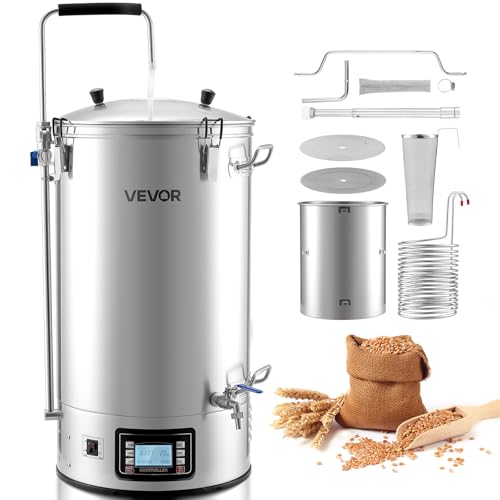
VEVOR 16 Gallon Brewing System (3000W)
Sixteen gallon all-in-one with anti-burn pump and wort chiller, sized for ten gallon batches.

FOHERE All-in-One Electric Brewing System (9.2 gal)
A 35 litre single-vessel electric system at entry pricing.
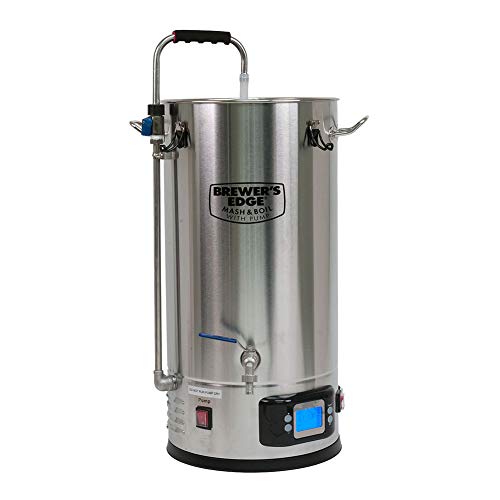
Brewer's Edge Mash and Boil with Pump (7.5 gal)
All-grain electric system with pump, 7.5 gallon capacity, no propane or separate mash tun required.

Brewer's Edge Mash and Boil
The original Mash and Boil, an electric mash tun and kettle in one vessel.

Inkbird ITC-308 Temperature Controller
Two stage plug-in thermostat that switches a fridge and a heater, which is how most brewers hold fermentation temperature.

Inkbird WiFi ITC-308 Temperature Controller
The WiFi version, which logs fermentation temperature and alerts you when it drifts.
Before you do this
Electric heating removes the carbon monoxide risk that comes with an indoor propane flame, but a unit with damaged wiring or a compromised heating element housing should never be operated, and cords and connections should stay clear of splashes and spills.
Related on BrewGearCalc
- Strike water calculator
- Boil-off calculator
- Best all-grain brewing systems
- Best wort chillers
- Brewing reference
Frequently asked questions
- Will an electric brewing system trip my breaker?
- It can, if the unit's wattage is high relative to what else is running on the same circuit. A standard US household circuit is commonly rated around 15 to 20 amps shared across everything plugged into it. A lower wattage unit like the 1500W VEVOR 8 Gallon Home Beer Brewer draws less current than a 3000W unit, so it is a safer choice on a circuit shared with other appliances.
- Can I brew with an electric system in my kitchen?
- Many home brewers do, since electric systems run on standard household power and do not need outdoor ventilation for combustion the way a propane burner does. Make sure the space has adequate ventilation for the steam a boil produces, keep cords and connections clear of splashes, and confirm the outlet you use is on a circuit that can handle the unit's wattage alongside anything else running on it.
- Is electric brewing safer than propane brewing?
- In one specific way, yes. A propane burner produces carbon monoxide as it burns, which is why it must stay outdoors, since the gas has no smell and can build up unnoticed in an enclosed space. An electric system has no combustion, so it removes that particular hazard. Electric systems still carry their own risks around water near electrical connections, so care around spills and damaged cords still matters.
- Do I need a pump on an electric system?
- No. A pump recirculates wort over the grain bed for more even mash temperatures and a faster move into boil, but a no-pump system like the Brewer's Edge Mash & Boil Series 2 works fine with manual stirring. Add a pump equipped unit like the Series 2 with Pump or the BrewZilla Gen 4 once you know recirculation is a workflow you actually want on brew day.
- What is the difference between the VEVOR 8 gallon and 16 gallon electric systems?
- Based on the published listings, the 8 gallon VEVOR Home Beer Brewer runs at 1500W and costs $149.90, while the 16 gallon VEVOR Brewing System runs at 3000W and costs $273.30. The larger unit holds more volume and heats with roughly double the wattage, which heats faster but also draws more current, so check your circuit before choosing the bigger unit.
- How do I know my electric system is holding the right mash temperature?
- A digital controller shows a set point, but confirming your actual mash temperature is holding steady still matters. Check readings with a separate digital thermometer at a few points during the mash, and run your recipe's target strike temperature through our strike water calculator ahead of brew day so the controller has an accurate number to hold, not a guess.
Researched from published brewing formulas, manufacturer specifications and verified owner reviews. This is general guidance, not professional advice.